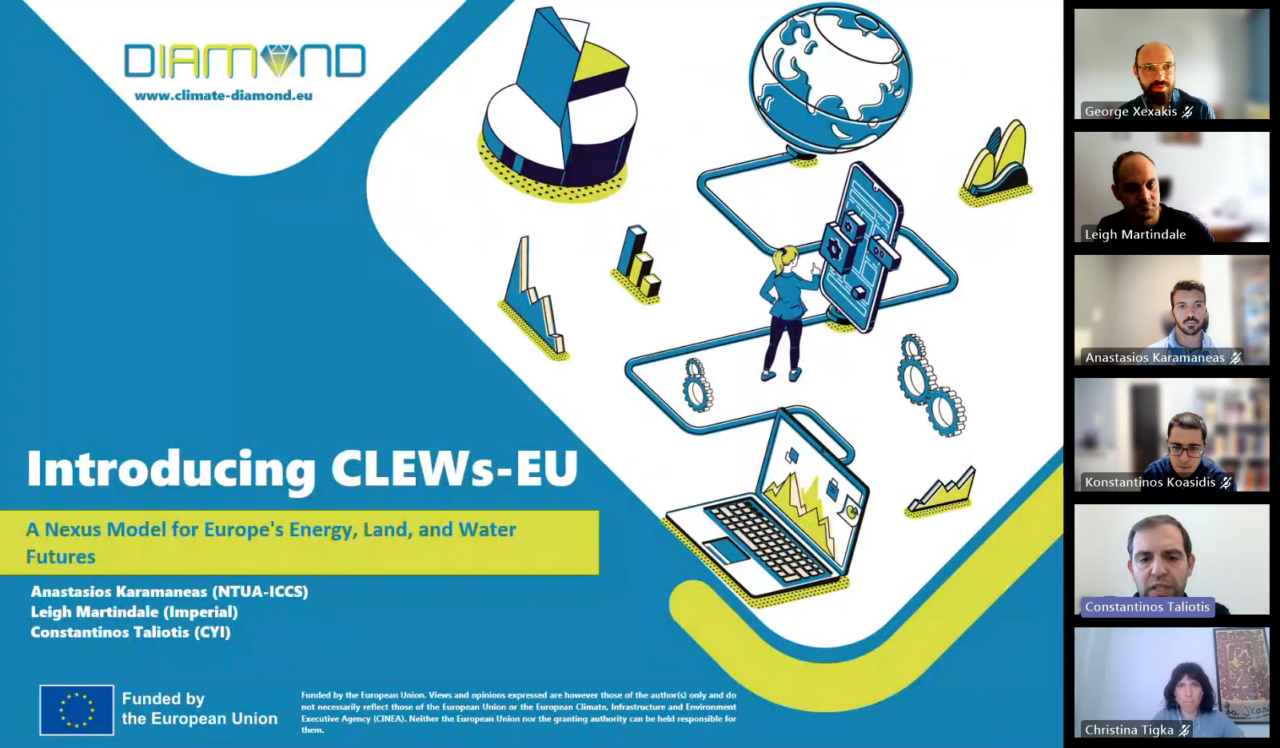
On 22 September 2026, DIAMOND hosted a dedicated online webinar introducing CLEWs-EU, the project’s open-source energy–water–land nexus model, to the modelling community and beyond. The webinar gathered over 26 participants including other CLEWs practitioners and members of the wider energy research community.
Designed for researchers and modellers interested in applying or further developing the model, the webinar provided a concise introduction to the CLEWs-EU framework, its methodology and structure, as well as the open-source documentation, manuals, and training resources available to support hands-on use.
The session opened with a short demonstration by Dr Leigh Martindale (Imperial College London) of SHORTFALL, a browser-based teaching tool designed to introduce learners to the cost-optimisation logic and energy systems modelling frameworks such as OSeMOSYS—the core optimisation basis of CLEWs-EU applications.
Dr Constantinos Taliotis (CYI) then presented the CLEWs-EU methodology and its development, highlighting the key enhancements in the new model version developed by DIAMOND. These include an aggregated EU model alongside a disaggregated version representing each of the 27 EU Member States, individual sector modules, a larger set of technology representation, explicit representation of water demand and supply, and the operationalisation of soft-linking with other models.
The webinar also placed particular emphasis on the model’s transparency and accessibility to new users. Dr Anastasios Karamaneas (ICCS/NTUA) presented the model’s open-source documentation and manuals, alongside available courses and training materials designed to support further capacity building.
The final part of the webinar explored CLEWs-EU’s reference and net-zero scenarios, including national and EU-level pathways and constraints (e.g., in biomass imports). Participants were also introduced to the CLEWs-EU Horizon Visualiser, presented by Dr. Leigh Martindale, which provides an accessible way of exploring results from the model’s EU aggregated version.
The session concluded with a discussion and exchange with participants, providing an opportunity to gather feedback on the model’s open-source code and licensing, time resolution, and other aspects relevant to its further use and development.
Overall, the webinar provided an introduction to the CLEWs-EU framework and its potential to explore interactions between integrated resource systems and their implications for technically feasible net-zero pathways in the EU. It also marked another step in DIAMOND’s ongoing efforts to make advancements in integrated assessment modelling more accessible to the wider modelling community.