Our Latest News

Exploring CLEWs-EU: DIAMOND introduces its open-source nexus model
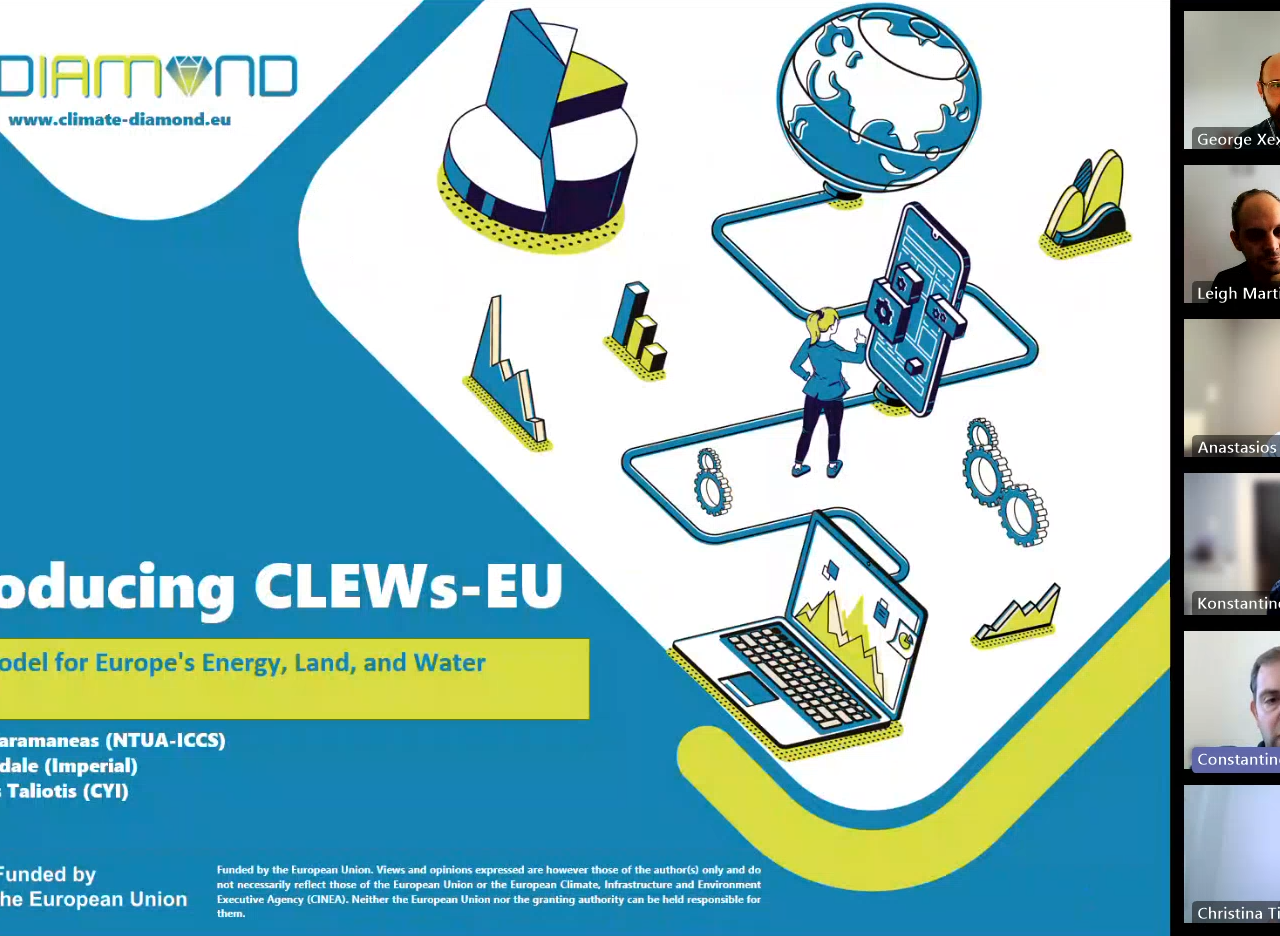
On 22 September 2026, DIAMOND hosted a dedicated online webinar introducing CLEWs-EU, the project’s open-source energy–water–land nexus model, to the modelling community and beyond. The webinar gathered over 26 participants including other CLEWs practitioners and members of the wider energy research community. Designed for researchers and modellers interested in applying or further developing the model,...
Read more
CLEWS-EU Webinar
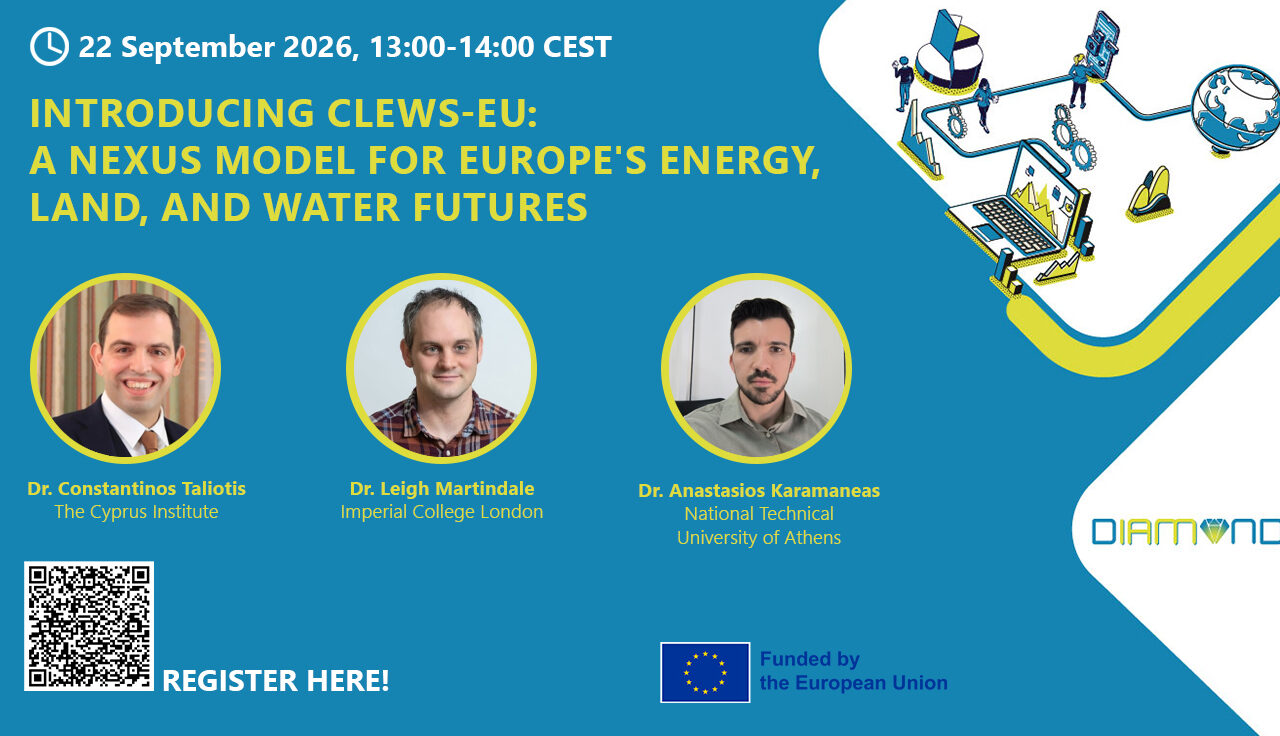
Introducing CLEWs-EU: A Nexus Model for Europe’s Energy, Land, and Water Futures
Understanding how energy, land, water, and climate systems interact is essential for designing coherent and resilient policy pathways. Yet many modelling tools treat these systems in isolation, limiting our ability to capture cross-sectoral trade-offs and synergies. The EU Horizon Europe project DIAMOND is organising a webinar to introduce the nexus model CLEWs-EU to the modelling community...
Read more
Computing and digitalisation through a multi-disciplinary lens – Call for papers
Artificial intelligence (AI), automation, and the Internet of Things are among the most significant drivers of change worldwide. Given myriad uncertainties for the future, multi-disciplinary research is crucial to understanding developments in this space going forward. A Special Issue in Energy and Climate Change welcomes accessible, decision-relevant research geared toward informing solutions and strategies relevant...
Read more
NEMESIS-World final public version released
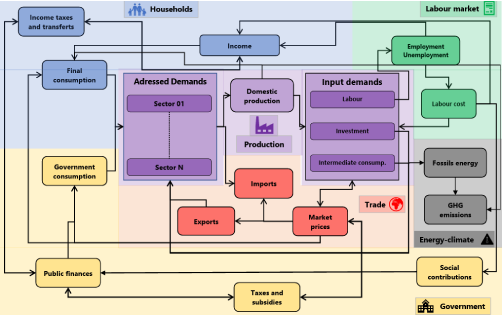
We are happy to announce the public release of the final version of NEMESIS-World! NEMESIS-World constitutes the first-of-its-kind publicly available, global, multi-country, multi-sector, recursive dynamic macroeconomic model to analyse the interplay of climate and economic policies. It is a system of interconnected economic models covering 22 world regions, dedicated to studying issues related to economic development, competitiveness, employment,...
Read more
CLEWs-EU final public version released
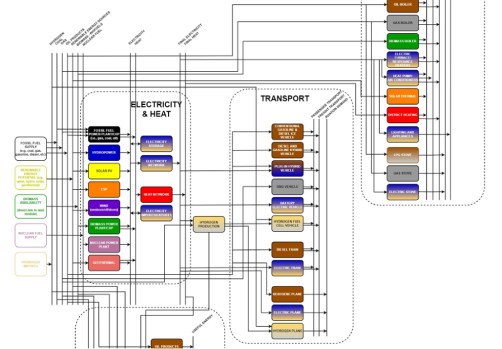
We are happy to announce the public release of the final version of one of our targeted models CLEWs-EU! The final version of the CLEWs-EU model, developed within the DIAMOND project, provides a fully open-source tool to examine in an integrated and internally consistent way the EU’s energy, land, and water systems. It explores the...
Read more

Models

Click on the diamond pieces to view
information about the models!

Models
OPEN-PROM OMNIA GCAM-Europe CLEWs-EU NEMESIS-World GEMINI-E3 EU

OPEN-PROM

  • Expand geographic granularity to at least 25 world regions, including G20 economies aswell as further disaggregating the EU-27 to the national level
  • Link to national results to analyse implementation challenges at the EU NUTS-2 level
  • Integrate trade aspects related to new clean sources in addition to fossil fuel trade.
  • Leverage probability distributions for model parameters enabling fully-fledged stochastic
    uncertainty treatment and more robust outputs
  •  Enable complete socioeconomic impact assessments of energy system transformations
    and net-zero pathways in the EU and major emitters

OMNIA

  • Enable more detailed regional analysis
  • Incorporate a spatially explicit representation of key energy carrier trades (bioenergy,
    hydrogen, commodities including captured CO2, etc.)
  • Allow to estimate global average temperature changes of scenarios and include
    abatement supply-cost curves for all major non-CO 2 options, based on updated
    assessments
  • Enable a broader community of practice

GCAM-Europe

  • Explore “what-if”-type scenarios deep-diving at the European national level, while
    staying connected with global trends and markets
  • Improve calibration data on energy use, emissions, land, and water for Europe
  • Increase the technological detail in buildings, transport, and industry
  • Connect the electricity sector in European countries through interconnected “grid-
    regions”, and improve dispatch and storage representation of electricity supply
  • Separate final consumer demand for energy and food by a wide and flexible segregation
    of consumer groups, including income groups

CLEWs-EU

  • Represent the EU as a single node, serving as an engagement, reduced-form model, upon
    which capacity development activities on EU climate policy can be developed
  • Extend spatial resolution to the national level to enable extensive, frontiers-stretching
    analysis
  • Adopt a more detailed temporal resolution to at least 12 time-steps (seasons and day-
    parts)
  • Enhance technological representation to increase the number of options that can render
    net-zero emission pathways technically feasible.

NEMESIS-World

  • Expand the focus of NEMESIS to acknowledge the global nature of aspects related to
    climate change and action and the importance of interactions within and outside the EU
  • Develop the first open-access, global, large-scale, macro-sectoral model
  • Individualise the largest economies/emitters, energy supply sectors and transport
    activities, with the selection of datasets reflecting optimal trade-off between coverage,
    detail, relation to official definitions, and need for updates

GEMINI-E3 EU

  • Enhance the level of detail in policy insights at the national and EU level, improving
    empirical consistency
  • Enhance representation of non-GHG pollutants, integrating health co-benefits
  • Enable the analysis of the EU’s net-zero transition to a circular economy, exploiting the
    advantages of CGE models in explicitly representing the role of prices for determining
    supply and demand for goods and accounting for economic flows throughout the
    economy

Partners

https://climate-diamond.eu/wp-content/uploads/2023/01/1.-ICCS-e1673612181707.png
Institute of Communication and Computer Systems

https://climate-diamond.eu/wp-content/uploads/2023/01/2.-BC3-e1673612206299.jpg
Basque Centre for Climate Change
https://climate-diamond.eu/wp-content/uploads/2023/01/3.-CESAR.png
Centre of Economic Scenario Analysis and Research

https://climate-diamond.eu/wp-content/uploads/2023/01/4.-CICERO-e1673612283870.png
CICERO Center for International Climate Research

https://climate-diamond.eu/wp-content/uploads/2023/01/CYI-e1673612377311.png
The Cyprus Institute
https://climate-diamond.eu/wp-content/uploads/2023/01/6.-E4SMA-e1673612776552.png
Energy Engineering Economic Environment System Modelling and Analysis

https://climate-diamond.eu/wp-content/uploads/2023/01/7.-HOLISTIC-e1673612543354.jpg
HOLISTIC
https://climate-diamond.eu/wp-content/uploads/2023/03/comillas.jpg
Comillas Pontifical University of Madrid
https://climate-diamond.eu/wp-content/uploads/2023/01/9.-ISINNOVA-2048x613.jpg
ISINNOVA
https://climate-diamond.eu/wp-content/uploads/2023/01/10.-SEURECO-e1673612711840.jpg
Société EURopéenne d'ECOnomie
https://climate-diamond.eu/wp-content/uploads/2023/01/11.-UM.png
Maastricht University
https://climate-diamond.eu/wp-content/uploads/2023/01/12.-ESMIA-e1673612796911.png
Energy Super Modelers and International Analysts

https://climate-diamond.eu/wp-content/uploads/2023/01/13.-UMD-CGS.png
University of Maryland
https://climate-diamond.eu/wp-content/uploads/2023/01/14.-EPFL-2048x596.png
Ecole Polytechnique Fédérale de Lausanne

https://climate-diamond.eu/wp-content/uploads/2023/01/15.-ETH-2048x342.png
Swiss Federal Institute of Technology in Zürich

https://climate-diamond.eu/wp-content/uploads/2023/01/16.-UNIBAS-2048x653.png
The University of Basel
https://climate-diamond.eu/wp-content/uploads/2023/01/17.-Imperial-e1673612988874.png
Imperial College London
https://climate-diamond.eu/wp-content/uploads/2023/01/18.-Oxford.png
The University of Oxford
https://climate-diamond.eu/wp-content/uploads/2023/01/19.-UCL-2048x601.png
The University College London