We are happy to announce the public release of the final version of one of our targeted models CLEWs-EU!
The final version of the CLEWs-EU model, developed within the DIAMOND project, provides a fully open-source tool to examine in an integrated and internally consistent way the EU’s energy, land, and water systems. It explores the behaviour and interactions between the energy system, water, agriculture and land use, economy, and climate in Europe, while improving calibration data and sectoral detail.
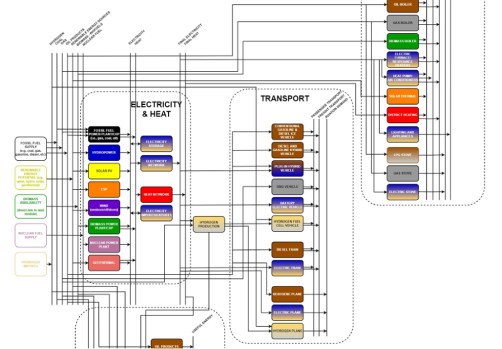
The CLEWs-EU model is developed within the OSeMOSYS (Open-Source Energy Systems Model) modelling framework ensuring that all energy service demands across buildings, industry, transport, and electricity supply are met while identifying the least-cost combination of technologies and resources.
CLEWs-EU builds on the structure of the Climate, Land (Food), Energy and Water systems (CLEWs) Global model, with several enhancements being implemented in this release. Two separate main modules, namely i) energy; and ii) land with water, have been developed with several interlinkages between them. Greenhouse gas emissions are tracked across the modules, while these are in turn affected by climate assumptions. In the energy module, a large set of technologies are used to represent primary energy supply, electricity generation, transport, buildings and industry, including a broader range of decarbonisation options (e.g., imported or locally produced hydrogen). In the land module, the available land resources for crop production, livestock grazing and other uses are being defined at the EU level and for each country individually, assessing the impact of policies and climate on water and energy. Furthermore, whereas the Global CLEWs model employs a simple accounting approach to calculate water requirements throughout the system, the CLEWs-EU model has a more explicit representation of water demand and supply.
Two geographical layers—an aggregated EU-wide version and a fully disaggregated model with member state granularity—allow exploratory high-level analysis and detailed country-specific assessment within the same framework. The aggregated version allows the exploration of climate change mitigation pathways by a broad range of stakeholders, while the national level disaggregation can be used for the more extensive analyses able to provide more focused insights and can be used to support development of national policies within the context of mutual EU obligations/targets.
The model is applied through a transparent pipeline: all scripts, input data, and assumptions are provided openly while a baseline scenario following current technology-cost trends and structural shifts is developed and projects far-reaching changes across Europe’s resource systems. Results show an energy system increasingly driven by electrification, energy efficiency interventions, and renewable energy deployment; a land and water system shaped by resource constraints and climate impacts; and emissions trajectories that vary sharply by sector.
The final version of the CLEWs-EU model provides a clear benchmark for evaluating more ambitious decarbonisation strategies and highlights the systemwide interactions that policymakers must navigate as Europe moves toward a more sustainable future.
You can access the model’s code including both versions via the CLEWs-EU GitHub repository here, and the online documentation here.