
Scientific Publications
Publications

-
2026
Reduced Complexity Model Intercomparison Project phase 3: experimental protocol for coordinated constraining and evaluation of reduced-complexity models

DATE: August 3rd, 2026
AUTHORS: Alejandro Romero-Prieto | Marit Sandstad | Benjamin M. Sanderson | Zebedee R. J. Nicholls | Norman J. Steinert | Thomas Gasser | Camilla Mathison | Jarmo Kikstra | Thomas J. Aubry | Katsumasa Tanaka | Konstantin Weber | Chris Smith
JOURNAL: Geoscientific Model Development
TITLE: Reduced Complexity Model Intercomparison Project phase 3: experimental protocol for coordinated constraining and evaluation of reduced-complexity models
SHORT DESCRIPTION:Reduced-Complexity Models (RCMs) are a critical tool for synthesising climate science knowledge and providing climate projections for a wide range of emissions scenarios. The Reduced-Complexity Model Intercomparison Project (RCMIP) provides a framework for the coordinated evaluation and application of these models. Here, we introduce the experimental protocol for RCMIP Phase 3 (RCMIP3), which is timed to inform the upcoming seventh assessment cycle of the Intergovernmental Panel on Climate Change (IPCC AR7). Taking stock of lessons from previous phases, RCMIP3 builds on community climate assessment products to support a common framework to compare RCM output against historical climate benchmarks. The experimental design aims to support a comprehensive assessment of RCMs across multiple climate-relevant domains, with a particular focus on carbon cycle dynamics and climate reversibility. The protocol is designed in tandem with the Coupled Model Intercomparison Project Phase 7 (CMIP7), replicating its “Assessment Fast Track” together with complementary experiments which explore wider state dependencies, sampling multiple scenario generations, long timescale response and diverse emissions-driven process representation.
JOURNAL LINK: https://doi.org/10.5194/gmd-19-7111-2026
ZENODO LINK:
SYNERGIES:
-
2026
A socioeconomic assessment of projected health impacts from outdoor air pollution under current European climate policy: A modelling study
DATE: June 19th, 2026
AUTHORS: Clàudia Rodés-Bachs | Jon Sampedro | Mercè Amich | Alexandros Nikas | Konstantinos Koasidis | Claudio Alejandro Belis | Dirk-Jan Van de Ven
JOURNAL: Social Science Research Network (SSRN)
TITLE: A socioeconomic assessment of projected health impacts from outdoor air pollution under current European climate policy: A modelling study
SHORT DESCRIPTION:Outdoor air pollution poses a major threat to human health and is closely interlinked to climate change, as both stem largely from the same emission sources and pollutants, affecting both health and climate. Despite sustained mitigation efforts, over 239,000 premature deaths in Europe were attributed to PM2.5 exposure in 2022, while climate policies are projected to yield substantial yet insufficient co-benefits by 2030, with uneven impacts across regions and socioeconomic groups.We applied GCAM-Europe to model emission pathways under the National Energy and Climate Plans (NECPs) and Fit-for-55 (FF55) policy package. Premature mortality attributable to PM2.5 was estimated at both 1 km2 grid and NUTS3 levels using rfasst. Results were further analysed through socioeconomic lens, both between and within countries, using quantitative assessments and machine learning techniques.Despite implementing the NECPs and FF55 packages, significant health risks persist by 2030, with average PM2.5 levels exceeding the World Health Organisation guidelines in all but seven European countries. The Balkan region and northern Italy emerge as the most affected areas, with national averages reaching up to 12.4 μg m−3. Urban populations face the greatest health risks, with disproportionate burdens among low- and high-income groups and areas with average concentrations of elderly residents. Within-country analyses reveal distinct, country-specific vulnerability patterns.Incorporating social and health dimensions into environmental policymaking is essential for designing strategies that jointly advance decarbonisation, reduce air pollution, and promote environmental justice. Attention to spatial resolution and geographic scale is critical, as coarse analyses risk obscuring vulnerable populations and regional disparities.
JOURNAL LINK: https://doi.org/10.1016/j.lanepe.2026.101754
ZENODO LINK:
SYNERGIES:
-
2026
Linking global Integrated Assessment and hybrid Input–Output models to support steel decarbonization policies in Europe

DATE: June 8th, 2026
AUTHORS: Debora Ghezzi | Lorenzo Rinaldi | Russell Horowitz | Dirk-Jan van de Ven | Georg Holtz | Alexander Jülich | Matteo Vincenzo Rocco
JOURNAL: Environmental Science & Technology
TITLE: Linking global Integrated Assessment and hybrid Input–Output models to support steel decarbonization policies in Europe
SHORT DESCRIPTION:Formulating decarbonization strategies for the European steel industry is crucial for meeting EU climate goals while preserving competitiveness. The present study develops an integrated modeling framework linking GCAM, a technology-rich global integrated assessment model, with the MARIO multiregional input–output framework to trace EU steel production, trade, and its direct and embedded greenhouse-gas emissions. Four scenarios are examined: a baseline aligned with current pledges and three pathways resembling major EU policy packages for 2025–2050, notably the Carbon Border Adjustment Mechanism (CBAM) and green-steel subsidy schemes. Results indicate that CBAM promotes low-emissions steel technologies, reduces total embedded emissions in EU steel consumption (up to −46% in 2030 and −23% in 2050), and helps stabilize the sector during the transition. Complementary green-steel support accelerates deployment of low-carbon production capacity and strengthens long-run competitiveness. Across scenarios, emission intensities of steel production fall (up to −80% in 2050), and consumption-based footprints associated with EU steel demand decline. The GCAM–MARIO coupling provides a transparent link between scenario design and economy-wide footprint accounting, illustrating how border measures and targeted subsidies interact. Overall, combining CBAM with sustained support for green-steel technologies offers an effective pathway to decarbonize the European steel industry while maintaining its international competitiveness.
JOURNAL LINK: https://doi.org/10.1021/acs.est.5c15099
ZENODO LINK:
SYNERGIES: IAM COMPACT
-
2026
Regional impacts on decarbonisation under evolving financing conditions for energy technologies

DATE: May 19th, 2026
AUTHORS: Natasha Frilingou | Dirk-Jan Van de Ven | Jon Sampedro | Russell Horowitz | Clàudia Rodés-Bachs | Thomas Nikolakakis | Anastasios Karamaneas | Kimon Georgiou | Konstantinos Koasidis | Shivika Mittal | Charalampos Platias | Conall Heussaff | Christoph Bertram | Alexandros Nikas
JOURNAL: Nature Communications
TITLE: Regional impacts on decarbonisation under evolving financing conditions for energy technologies
SHORT DESCRIPTION:Energy-sector decarbonisation requires large-scale investment in low-carbon technologies, yet only a limited share flows to low- and middle-income countries, partly due to higher financing costs and perceived risks. Most modelling exercises do not fully account for how the cost of capital may vary across regions and technologies, potentially influencing policy insights. We examine how plausible, expert-informed long-term trends in de-risking clean energy and increasing risks for fossil fuels could shape decarbonisation pathways, using an empirical dataset differentiated by country and technology. We also evaluate a “corrective justice” policy that taxes corporate windfall profits and redistributes revenues to support low-carbon investments in higher-risk regions. Results suggest that incorporating differentiated cost-of-capital trajectories may improve mitigation outcomes and help narrow the gap between current commitments and long-term climate targets, while indicating potential underestimation of risks associated with bioenergy-based negative emissions technologies in mitigation scenarios for high-income nations.
JOURNAL LINK: https://doi.org/10.1038/s41467-026-73522-1
ZENODO LINK:
SYNERGIES: IAM COMPACT
-
2026
The challenge with climate-energy-economy models in constructing fair and equitable climate futures

DATE: May 10th, 2026
AUTHORS: Alexandros Nikas | Jon Sampedro | Alaa Al Khourdajie | Iñaki Arto | Sergio Balderrama | Elin Lerum Boasson | Anton Cartwright | Felipe Feijoo | Panagiotis Fragkos | Natasha Frilingou | Xaquin García-Muros | Victoria Herbig | Anastasios Karamaneas | Konstantinos Koasidis | Lin Ma | Shivika Mittal | Melina Moleskis | Thomas Nikolakakis | Minal Pathak | Glen Peters | Charalampos Platias | Robert Carl Pietzcker | Selim Raihan | Clàudia Rodés-Bachs | Joeri Rogelj | Aleksander Śniegocki | Ida Sognnæs | Pantelis Solomou | Dimitra Spatharidou | Constantinos Taliotis | Christina Tigka | Manuel Tomás | Georgios Trachanas | Ioannis Tsipouridis | Dirk-Jan van de Ven | Bianca Vienni-Baptista | Theodoros Zachariadis | Athanasia Arnokourou | Evi Makri | Ajay Gambhir | Kurt Kratena | Georgios Xexakis
JOURNAL: Futures
TITLE: The challenge with climate-energy-economy models in constructing fair and equitable climate futures
SHORT DESCRIPTION:Climate change and policy are unevenly experienced across nations, social groups, households, sectors, and generations. Understanding how benefits and burdens of climate action can be equitably shared is therefore critical. While the cornerstone concept of ‘common but differentiated responsibilities and respective capabilities’ is broadly accepted, the absence of consensus on equitable effort-sharing principles presents a challenge that permeates science underpinning climate policy. Climate-energy-economy models exhibit considerable conceptual, structural, and technical limitations in constructing equitable climate futures: they aggregate diverse Global South countries into homogeneous regions, fail to capture critical elements of international climate finance, and tend to produce one-size-fits-all strategies with limited consideration of local contexts. Model-based studies, additionally, have been argued to reflect Global North narratives in international scenario ensembles, assume persisting inequalities between the Global North and the Global South in the future, obscure ethical or normative choices behind operationalised principles of justice, and fail to systematically include stakeholders and scientists from the Global South. Here, we explore how modelling science can be more inclusive and effective in recognising these issues and co-constructing just climate futures. While acknowledging the inherent limitations of any modelling exercise, we argue that progress depends on several key actions, including meaningfully collaborating with stakeholders and scientists from other disciplines and critically from hitherto underrepresented and underfunded regions, incorporating wider policy priorities beyond mitigation, improving data and modelling capabilities to better represent the varied conditions of different communities, and integrating elements, policies, and governance structures that are indispensable to representing climate finance considerations.
JOURNAL LINK: https://doi.org/10.1016/j.futures.2026.103850
ZENODO LINK:
SYNERGIES: IAM COMPACT
-
2026
Sub-national implications of Greece’s power-sector transition: The HERMES energy-system model

DATE: May 9th, 2026
AUTHORS: Anastasios Karamaneas | Thomas Nikolakakis | Kimon Georgiou | Sophia Kokoni | Constantinos Taliotis | Vignesh Sridharan | Leigh Martindale | Natasha Frilingou | Konstantinos Koasidis | Georgios Xexakis | Georgios P. Trachanas | Vangelis Marinakis | Haris Doukas | John Psarras | Alexandros Nikas
JOURNAL: Energy Strategy Reviews
TITLE: Sub-national implications of Greece's power-sector transition: The HERMES energy-system model
SHORT DESCRIPTION:Greece has set ambitious energy and climate targets, aiming to decarbonise its power sector by 2050, despite the sector’s geographical complexity and historical coal reliance. Delivering on this goal entails multiple challenges, including temporal and geographical stochasticity of renewable electricity generation, integration of energy storage technologies, variable renewables curtailment, and management of electricity flows at cross-regional and cross-border scales. Navigating this complex landscape requires the use of sophisticated energy-system modelling tools. We introduce the Hellenic Regional Model for the Electricity System (HERMES) for Greece’s power sector, based on the OSeMOSYS open-source modelling framework and drawing on state-of-the-art developments in its community. The HERMES model features high temporal and technological granularity, while critically offering insights disaggregated at the NUTS-2 and island level. The paper documents all methodological novelties and extensions, evaluates the model’s robustness and accuracy against recent historical data as well as official trajectories of the country’s National Energy and Climate Plan (NECP), and illustrates its analytical added value through insightful sub-national implications of the NECP—including RES deployment patterns and unit-dispatch outcomes in regions with increased policy-relevant insights. Our results emphasise the central role of strengthening cross-regional transmission capacity and insular grid interconnections for energy security alongside decarbonisation as well as the significance of cross-regional and cross-border electricity exchanges in the country’s ambition to emerge as an intercontinental energy hub. The analysis also sheds light on certain distributional implications of the energy transition and the vital contribution of storage technologies to achieving a near-zero emissions power sector by 2050.
JOURNAL LINK: https://doi.org/10.1016/j.esr.2026.102265
ZENODO LINK:
SYNERGIES:
-
2026
Artificial intelligence to support cross-disciplinary climate change research

DATE: April 28th, 2026
AUTHORS: Yang Ou | Carlos Rodriguez-Pardo | Alaa Al Khourdajie | Joeri Rogelj | Peijie Zhou | Karthik Mukkavilli | Massimo Tavoni | Leon Clarke | Yong Liu | Tengjiao Wang | Alice Oh | Haewon McJeon
JOURNAL: Nature Climate Change
TITLE: Artificial intelligence to support cross-disciplinary climate change research
SHORT DESCRIPTION:Integrating knowledge across climate risks, societal responses and their interactions is a critical yet persistently challenging goal. We argue that advanced artificial intelligence frameworks, specifically foundation models, offer a new opportunity to unify these domains and support climate decision-making.
JOURNAL LINK: https://doi.org/10.1038/s41558-026-02624-x
ZENODO LINK:
SYNERGIES: IAM COMPACT
-
2026
Potential futures for the IPCC’s approach to artificial intelligence

DATE: April 27th, 2026
AUTHORS: Holly Jean Buck | Alaa Al Khourdajie | Shinichiro Asayama | Oliver Geden
JOURNAL: Communications Earth & Environment
TITLE: Potential futures for the IPCC’s approach to artificial intelligence
SHORT DESCRIPTION:During the first six assessment cycles of the Intergovernmental Panel on Climate Change (IPCC), generative artificial intelligence (AI) tools were not widely available. This has rapidly changed. The IPCC will need to make choices about how to use artificial intelligence powered applications in literature identification, literature assessment, and communicating the contents of the report. These are not merely technical decisions, but sociopolitical challenges, as the IPCC has a social function of creating a shared basis of reality for addressing climate change. To explore these challenges, this paper describes four scenarios of potential AI development: rapid adoption of AI agents, perceptions of superior AI reliability, caution among the research community, and public backlash to AI. If the IPCC can navigate these emergent challenges, there is an opportunity for it to serve as a learning opportunity for other institutions grappling with how to do scientific assessment in a world with generative AI.
JOURNAL LINK: https://doi.org/10.1038/s43247-026-03514-y
ZENODO LINK:
SYNERGIES: IAM COMPACT
-
2026
From least-cost to SDG-optimal sectoral allocation of Paris Agreement-compatible mitigation efforts
DATE: April 7th, 2026
AUTHORS: Dirk-Jan van de Ven | Clàudia Rodés-Bachs | Théo Rouhette | Russell Horowitz | Jon Sampedro | Alexandros Nikas | Natasha Frilingou | Xin Zhao | Abhishek Chaudhary | Gokul Iyer | Jorge Moreno | Konstantinos Koasidis
JOURNAL: Nature Climate Change
TITLE: From least-cost to SDG-optimal sectoral allocation of Paris Agreement-compatible mitigation efforts
SHORT DESCRIPTION:Limiting global warming to well below 2 °C necessitates profound decarbonization, but how to distribute mitigation efforts over sectors remains a widely debated issue. Although integrated assessment models traditionally rely on ‘least-cost’ optimization to answer this question, the resulting sectoral allocations vary widely and ignore impacts on other potential policy objectives. Here we connect an integrated assessment models with a portfolio analysis to evaluate how sector-specific mitigation actions impact key indicators from Sustainable Development Goals (SDGs) related to poverty, health, water, economy and land, and to identify Pareto-optimal and Paris-compliant mitigation portfolios that reveal the trade-offs between other sustainable development priorities. Furthermore, we define ‘SDG-balanced’ portfolios that, in most cases, outperform standard least-cost scenarios across all five SDG indicators for an equivalent carbon budget. Our findings demonstrate that the simultaneous evaluation of a broader set of policy priorities is crucial to provide truly policy-relevant guidance for the climate transition.
JOURNAL LINK: https://www.nature.com/articles/s41558-026-02602-3.epdf?sharing_token=i2jHubtabkELtMZDs8FP0dRgN0jAjWel9jnR3ZoTv0PwUCSEYyrLWyOTcnQHQeWzkV_QT_7aPOSMW9eKHk_2fBkJ-5tpHyIEEdVmZtoPZoRcTonX6yERcDhIty08Mg9ERZvmjTNDuQ_aLouhaV4h3w0aLrpfQ4_RydT38Hii-E0%3D
ZENODO LINK:
SYNERGIES: IAM COMPACT
-
2026
Trade war to cooperation: scrutinizing China’s strategies to the EU carbon border adjustment mechanism
DATE: March 14th, 2026
AUTHORS: Sigit Perdana | Marc Vielle | Ru Li
JOURNAL: Review of World Economics
TITLE: Trade war to cooperation: scrutinizing China’s strategies to the EU carbon border adjustment mechanism
SHORT DESCRIPTION:This paper delves into the anticipated impact of the European Union’s Carbon Border Adjustment Mechanism (EU CBAM) on its trading partners, with a particular focus on China. Centralizing to China’s critical sectors of iron, steel, and aluminum, findings suggest the CBAM may complicate the EU-China trade war, exacerbating trade imbalances. Analysis of various scenarios of potential retaliatory measures and policy alternatives for China reveal possible escalation into a trade conflict between the EU and China, with potential retaliatory measures improving China’s welfare but posing economic costs. The EU CBAM may also introduce trade discriminatory implications favoring the EU, raising concerns about WTO compliance. China might adhere by engaging in resource shuffling, such as offsetting emissions or prioritizing the use of green electricity solely for exports to the EU. This approach has demonstrated beneficial outcomes, enhancing both production efficiency and overall welfare. These findings suggest the importance of the coercive measures in facilitating collective implementation for more effective CBAM implementation. The complex dynamics between the EU and China underscore the multifaceted challenges and potential consequences associated with the EU CBAM.
JOURNAL LINK: https://doi.org/10.1007/s10290-026-00635-6
ZENODO LINK:
SYNERGIES: ENTICE
-
2026
From consultation to inclusive engagement: Advancing participatory modeling for net-zero sustainable development

DATE: March 13th, 2026
AUTHORS: Victoria Herbig | Stephanie Briers | Bianca Vienni-Baptista
JOURNAL: Environmental Science & Policy
TITLE: From consultation to inclusive engagement: Advancing participatory modeling for net-zero sustainable development
SHORT DESCRIPTION:Traditional modeling approaches for net-zero, sustainable development often prioritize technical and expert-driven inputs, producing outputs that overlook critical institutional and behavioral considerations. Although there has been growing interest in participatory approaches and transdisciplinary research in modeling, most processes currently stop at consultation, missing opportunities for deeper stakeholder integration. This paper introduces a structured framework for embedding inclusivity into participatory modeling for Integrated Assessment Models (IAMs). Drawing on a mixed-methods study, including a systematic literature review, an online stakeholder survey, and semi-structured interviews with modelers and members of a EU-funded project, we identify three interlinked pillars for an inclusive modeling environment: i) stakeholder representation, ii) engagement dynamics, and iii) collective decision-making. We argue that inclusive participatory modeling is not merely a procedural improvement but a strategic necessity for building models – and informing policies – that are credible, resilient, and socially relevant.
JOURNAL LINK: https://doi.org/10.1016/j.envsci.2026.104352
ZENODO LINK:
SYNERGIES:
-
2026
Global implications of uncertainty in China’s climate policy delivery

DATE: March 6th, 2026
AUTHORS: Dan Zhang | Steve Pye | Jim Watson | James Price | Dan Welsby
JOURNAL: Nature Communications
TITLE: Global implications of uncertainty in China’s climate policy delivery
SHORT DESCRIPTION:The delivery of China’s climate policy has substantial global implications, yet persistent gaps between policy targets and implementation raise concerns about policy credibility. This study presents a structured credibility assessment of 292 targets across 58 national climate and energy policies, including China’s updated 2035 NDC. We apply a morphological scenario framework to examine interactions between policy uncertainty and socio-economic and technological drivers, embedding these scenarios in an integrated assessment model under two global contexts: one aligned with current NDCs and one consistent with global net-zero ambition. We find that timely or accelerated delivery of China’s net-zero target could partially offset insufficient ambition elsewhere by mid-century. Full delivery by 2050 reduces global CO₂ emissions to 13 Gt, compared with 23 Gt without such policies. Policy delivery uncertainty alone could imply up to ~500 GtCO₂ difference in cumulative emissions by 2100 (~0.17 °C warming).
JOURNAL LINK: https://doi.org/10.1038/s41467-026-70400-8
ZENODO LINK:
SYNERGIES:
-
2026
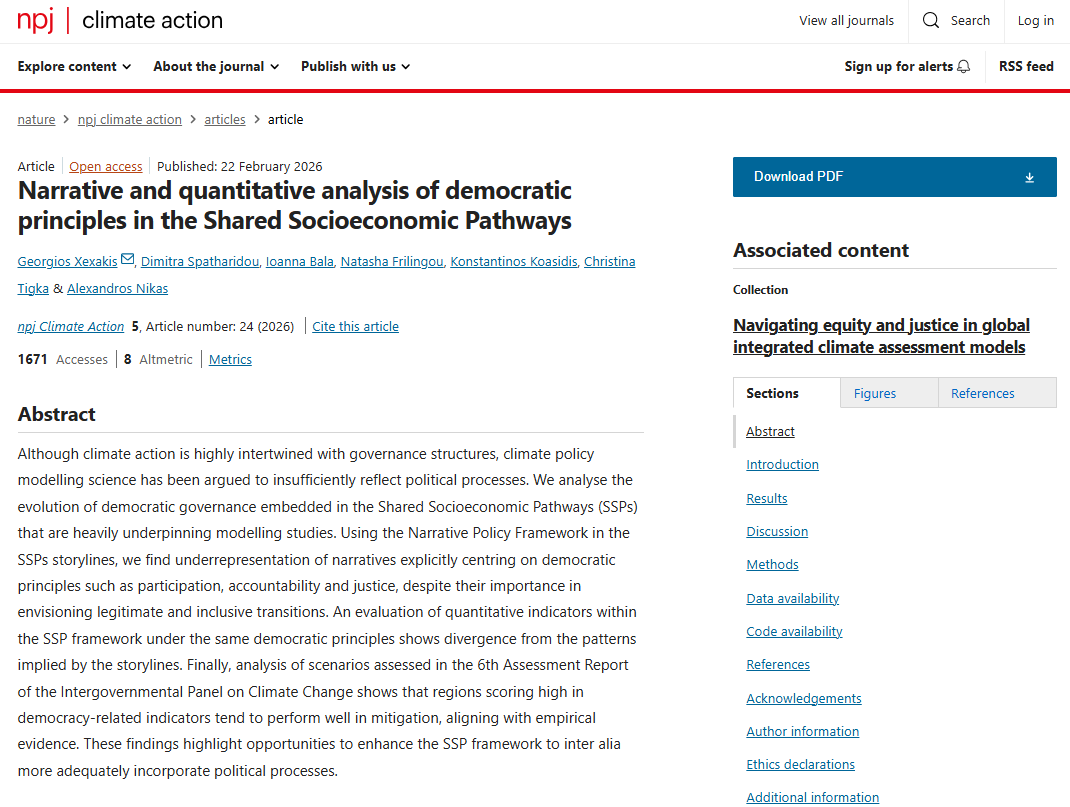
Narrative and quantitative analysis of democratic principles in the Shared Socioeconomic Pathways
DATE: February 22nd, 2026
AUTHORS: Georgios Xexakis | Dimitra Spatharidou | Ioanna Bala | Natasha Frilingou | Konstantinos Koasidis | Christina Tigka | Alexandros Nikas
JOURNAL: npj - Climate Action
TITLE: Narrative and quantitative analysis of democratic principles in the Shared Socioeconomic Pathways
SHORT DESCRIPTION:Although climate action is highly intertwined with governance structures, climate policy modelling science has been argued to insufficiently reflect political processes. We analyse the evolution of democratic governance embedded in the Shared Socioeconomic Pathways (SSPs) that are heavily underpinning modelling studies. Using the Narrative Policy Framework in the SSPs storylines, we find underrepresentation of narratives explicitly centring on democratic principles such as participation, accountability and justice, despite their importance in envisioning legitimate and inclusive transitions. An evaluation of quantitative indicators within the SSP framework under the same democratic principles shows divergence from the patterns implied by the storylines. Finally, analysis of scenarios assessed in the 6th Assessment Report of the Intergovernmental Panel on Climate Change shows that regions scoring high in democracy-related indicators tend to perform well in mitigation, aligning with empirical evidence. These findings highlight opportunities to enhance the SSP framework to inter alia more adequately incorporate political processes.
JOURNAL LINK: https://doi.org/10.1038/s44168-026-00351-9
ZENODO LINK:
SYNERGIES: RETOOL
-
2026
Cost-optimal vs. policy-driven scenarios for a decarbonised European energy system

DATE: February 10th, 2026
AUTHORS: Natasha Frilingou | Dirk-Jan Van de Ven | Jon Sampedro | Alexandre Torné | Evelina Trutnevyte | Russell Horowitz | Clàudia Rodés-Bachs | Konstantinos Koasidis | Shivika Mittal | George Xexakis | Alexandros Nikas
JOURNAL: Environmental Research Letters
TITLE: Cost-optimal vs. policy-driven scenarios for a decarbonised European energy system
SHORT DESCRIPTION:The European Union’s (EU) climate strategy—anchored in the European Green Deal, the Fit-for-55 package, and updated National Energy and Climate Plans (NECPs)—requires a rapid transformation of the energy system to meet the legally binding target of net-zero greenhouse gas emissions by 2050 and a 55% reduction by 2030 relative to 1990 levels. Yet, how national plans align with EU-wide ambition, alongside the implications for investment, infrastructure, and power-system operation, remain insufficiently assessed. We address this gap by linking an EU-specific implementation of a prominent integrated assessment model with Member State-level disaggregation (GCAM-Europe) with a higher-resolution European electricity system model (EXPANSE). This modelling framework captures national heterogeneity, sectoral detail, and spatiotemporal variability in electricity demand, renewable supply, storage, and grid constraints. We analyse four scenarios representing EU-wide (Fit-for-55) or national (NECP) targets, implemented through either explicit policies (POLICY) or cost-optimal carbon caps (FREE). Results show that all scenarios achieve the − 55% fossil CO2 reduction by 2030, with the electricity sector driving the largest chunk. Renewable energy nearly doubles, with POLICY scenarios accelerating electrification and heat pump deployment, while FREE scenarios lean more on biofuels. Efficiency targets are only partially met, with POLICY scenarios distributing savings more evenly across Member States compared to concentrated reductions (FREE). By 2035, power system transformation diverges strongly: FREE scenarios expand about 1,160 GW of new capacity, concentrated in a few resource-rich regions, while POLICY scenarios reach around 1,680 GW with broader spatial distribution, requiring higher overall investment in renewables and grids. Average wholesale electricity prices are higher and more heterogeneous under POLICY scenarios, reflecting carbon costs, transmission bottlenecks, and reliance on fossil backup. These results highlight trade-offs between economic efficiency and equitable burden-sharing, underscoring the importance of coordinated EU governance, infrastructure planning, and complementary policies to balance cost-effectiveness with political feasibility and social acceptance.
JOURNAL LINK: https://iopscience.iop.org/article/10.1088/1748-9326/ae3f45
ZENODO LINK:
SYNERGIES: IAM COMPACT
-
2026
A decade of energy-system modelling for Greece: a systematic literature review

DATE: February 1st, 2026
AUTHORS: Anastasios Karamaneas | Konstantinos Koasidis | Thomas Nikolakakis | Natasha Frilingou | Constantinos Taliotis | Georgios P. Trachanas | Sophia Kokoni | Konstantinos Kostas | Stratis Alexandrou | Christina Tigka | Georgios Xexakis | Vangelis Marinakis | Haris Doukas | John Psarras | Alexandros Nikas
JOURNAL: Energy Strategy Reviews
TITLE: A decade of energy-system modelling for Greece: a systematic literature review
SHORT DESCRIPTION:As an EU Member State, Greece has adopted increasingly ambitious climate change mitigation targets and policies, particularly following the adoption of the Paris Agreement and EU-driven ambition, with the overarching goal of achieving a net-zero economy by 2050. This study presents a systematic literature review of energy-system modelling studies for Greece published in the period 2015–2025, investigating how research teams conceptualise the Greek energy sector of the future, the modelling frameworks employed, and the methodological trends that have emerged. Our review’s findings indicate that more than half of the reviewed studies rely on ad hoc models developed for single applications, notably often lacking transparency, openness, and replicability traits, and that most models identified in the reviewed literature are based on cost minimisation approaches. The review also reveals that numerous applications fail to inform longer-term planning (i.e., to cover the critical decades ahead, towards decarbonisation), regional aspects, and/or key aspects of the ever-evolving Greek energy sector, such as variable renewable energy curtailment, hydrogen production and storage, or unit dispatch, although energy storage and electricity exchange have been gaining traction. Bridging these gaps in future modelling research can be facilitated by wider adoption of open-source and well-documented modelling frameworks as well as of open science and FAIR data principles. New studies can adopt models featuring increased spatial and temporal granularity, either by enhancing existing tools or by coupling different modelling frameworks to refrain from computationally demanding approaches while still capturing the increasing complexity of the energy transition in Greece.
JOURNAL LINK: https://doi.org/10.1016/j.esr.2026.102088
ZENODO LINK:
SYNERGIES: THESEUS
-
2026
IAM-FIRE: a climate emulator–based framework to project wildfire impacts and risks for Integrated Assessment Models (preprint)
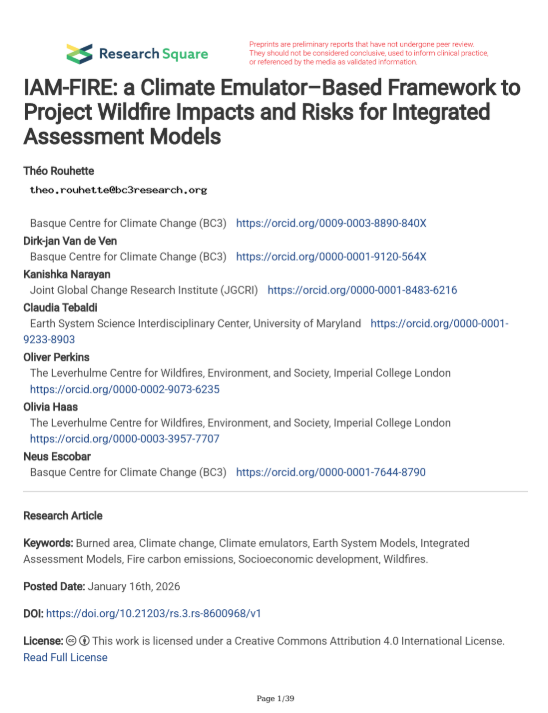
DATE: January 16th, 2026
AUTHORS: Théo Rouhette | Dirk-jan Van de Ven | Kanishka Narayan | Claudia Tebaldi | Oliver Perkins | Olivia Haas | Neus Escobar
JOURNAL: Research Square
TITLE: IAM-FIRE: a climate emulator–based framework to project wildfire impacts and risks for Integrated Assessment Models (preprint)
SHORT DESCRIPTION:Most Integrated Assessment Models (IAMs) underrepresent dynamic feedbacks from climate-driven disturbances such as wildfires, potentially overestimating the permanence of land-based carbon sinks. In particular, representing the impacts of forest fires is becoming increasingly important, as these are expected to intensify in the coming years. We introduce IAM-FIRE (Integrated Assessment Model – Fire Impacts & Risks Emulator), a novel framework that enables the projection of wildfire burned area (BA) and carbon emissions (CE) directly from IAM outputs. IAM-FIRE combines a spatial climate emulator, land-use downscaling, vegetation productivity modelling, and an empirical fire model to generate global annual wildfire impacts for arbitrary socioeconomic and emissions scenarios at 0.5° resolution for the period 2020–2100.
Calibrated against GFEDv5 observations and using inputs from the Global Change Analysis Model (GCAM), we report projections BA and CE derived from IAM-FIRE for four scenarios: SSP1-2.6, SSP2-4.5, SSP3-6.6 and SSP5-7.6. The model reproduces historical global trends for total BA, including the observed global decline since the early 2000s, and for forest BA. Projected fire trajectories differ strongly among scenarios: total BA range from declines under SSP1-2.6 (−3.36 Mha yr-1) to increases under SSP3-6.6 (+1.6 Mha yr-1). Corresponding total CE show a similar divergence ranging from −15 to +10.6 TgC yr-1. Socioeconomic development exerts a dominant suppressing effect on wildfire impacts while climate change and CO₂-driven increases in vegetation productivity amplify fire risk, particularly under high-emissions pathways.
Compared with CMIP6 fire-enabled Earth System Models, IAM-FIRE exhibits greater sensitivity to radiative forcing and a stronger role for human-driven fire suppression, highlighting substantial structural uncertainties in future fire projections. By providing a computationally efficient and internally consistent approach to represent wildfire impacts within IAMs, IAM-FIRE enables systematic exploration of fire–climate–land feedbacks and supports improved assessments of mitigation permanence and climate risks in future integrated scenarios.
JOURNAL LINK: https://doi.org/10.21203/rs.3.rs-8600968/v1
ZENODO LINK:
SYNERGIES: ACCLIMATE
-
2026
Cooperation in global renewable hydrogen trade significantly improves welfare outcomes and increases trade volume (preprint)
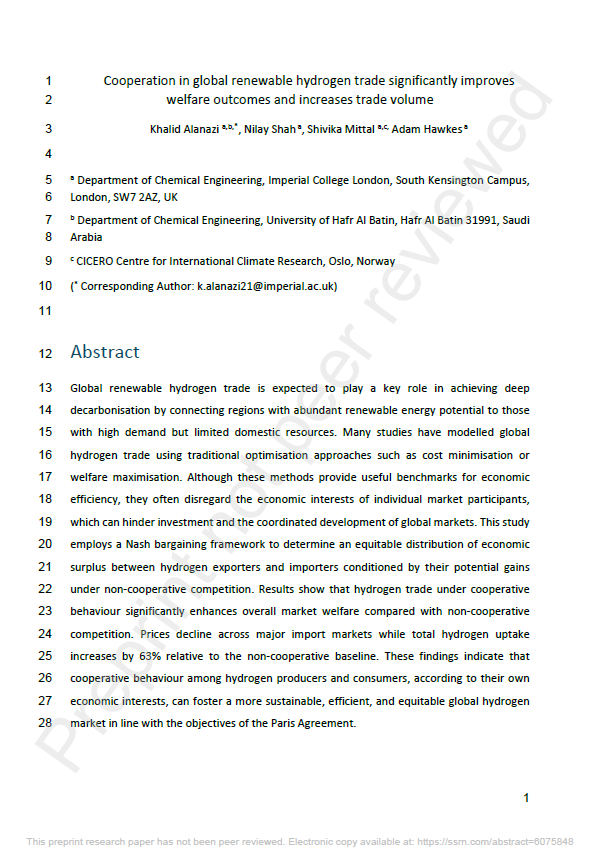
DATE: January 15th, 2026
AUTHORS: Khalid Alanazi | Nilay Shah | Shivika Mittal | Adam Hawkes
JOURNAL: Social Science Research Network (SSRN)
TITLE: Cooperation in global renewable hydrogen trade significantly improves welfare outcomes and increases trade volume (preprint)
SHORT DESCRIPTION:Global renewable hydrogen trade is expected to play a key role in achieving deep decarbonisation by connecting regions with abundant renewable energy potential to those with high demand but limited domestic resources. Many studies have modelled global hydrogen trade using traditional optimisation approaches such as cost minimisation or welfare maximisation. Although these methods provide useful benchmarks for economic efficiency, they often disregard the economic interests of individual market participants, which can hinder investment and the coordinated development of global markets. This study employs a Nash bargaining framework to determine an equitable distribution of economic surplus between hydrogen exporters and importers conditioned by their potential gains under non-cooperative competition. Results show that hydrogen trade under cooperative behaviour significantly enhances overall market welfare compared with non-cooperative competition. Prices decline across major import markets while total hydrogen uptake increases by 63% relative to the non-cooperative baseline. These findings indicate that cooperative behaviour among hydrogen producers and consumers, according to their own economic interests, can foster a more sustainable, efficient, and equitable global hydrogen market in line with the objectives of the Paris Agreement.
JOURNAL LINK: https://ssrn.com/abstract=6075848
ZENODO LINK:
SYNERGIES:
-
2025
Reduced Complexity Model Intercomparison Project Phase 3: Experimental protocol for coordinated constraining and evaluation of Reduced-Complexity Models (preprint)
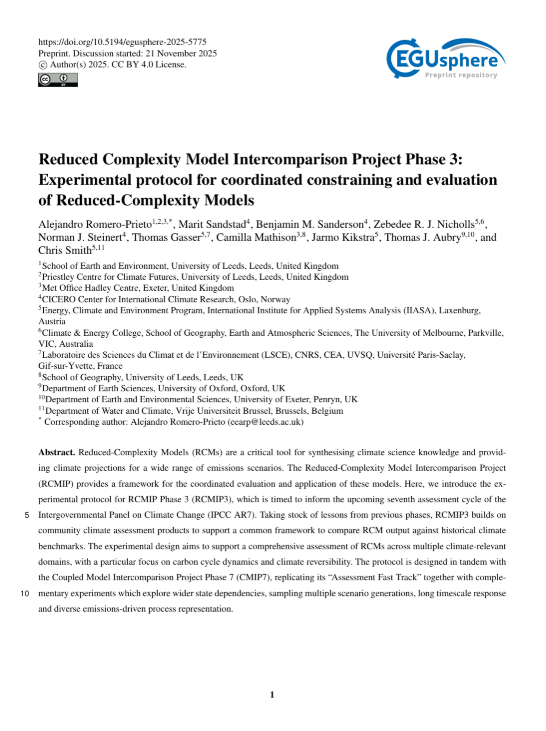
DATE: November 21st, 2025
AUTHORS: Alejandro Romero-Prieto | Marit Sandstad | Benjamin M. Sanderson | Zebedee R. J. Nicholls | Norman J. Steinert | Thomas Gasser | Camilla Mathison | Jarmo Kikstra | Thomas J. Aubry | Chris Smith
JOURNAL: EGUsphere
TITLE: Reduced Complexity Model Intercomparison Project Phase 3: Experimental protocol for coordinated constraining and evaluation of Reduced-Complexity Models (preprint)
SHORT DESCRIPTION:Reduced-Complexity Models (RCMs) are a critical tool for synthesising climate science knowledge and providing climate projections for a wide range of emissions scenarios. The Reduced-Complexity Model Intercomparison Project (RCMIP) provides a framework for the coordinated evaluation and application of these models. Here, we introduce the experimental protocol for RCMIP Phase 3 (RCMIP3), which is timed to inform the upcoming seventh assessment cycle of the Intergovernmental Panel on Climate Change (IPCC AR7). Taking stock of lessons from previous phases, RCMIP3 builds on community climate assessment products to support a common framework to compare RCM output against historical climate benchmarks. The experimental design aims to support a comprehensive assessment of RCMs across multiple climate-relevant domains, with a particular focus on carbon cycle dynamics and climate reversibility. The protocol is designed in tandem with the Coupled Model Intercomparison Project Phase 7 (CMIP7), replicating its “Assessment Fast Track” together with complementary experiments which explore wider state dependencies, sampling multiple scenario generations, long timescale response and diverse emissions-driven process representation.
JOURNAL LINK: https://doi.org/10.5194/egusphere-2025-5775
ZENODO LINK:
SYNERGIES:
-
2025
Enhancing energy and food access through reduction of income inequality does not jeopardize the achievement of existing climate pledges (letter)
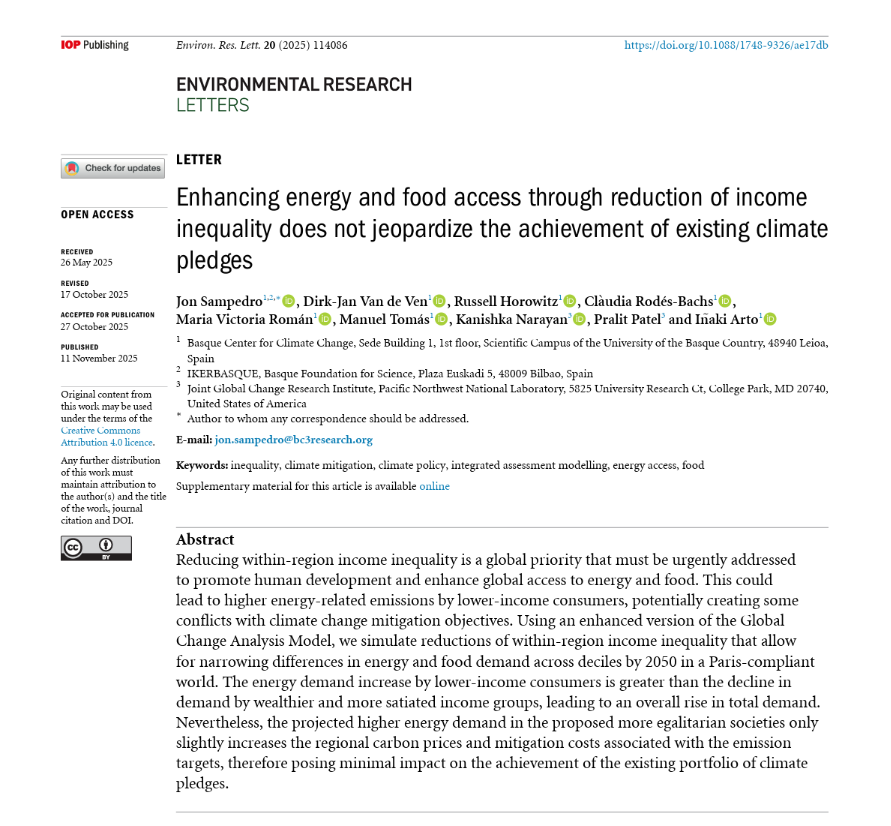
DATE: November 11th, 2025
AUTHORS: Jon Sampedro | Dirk-Jan Van de Ven | Russell Horowitz | Clàudia Rodés-Bachs | Maria Victoria Román | Manuel Tomás | Kanishka Narayan | Pralit Patel | Iñaki Arto
JOURNAL: Environmental Research Letters
TITLE: Enhancing energy and food access through reduction of income inequality does not jeopardize the achievement of existing climate pledges (letter)
SHORT DESCRIPTION:Reducing within-region income inequality is a global priority that must be urgently addressed to promote human development and enhance global access to energy and food. This could lead to higher energy-related emissions by lower-income consumers, potentially creating some conflicts with climate change mitigation objectives. Using an enhanced version of the Global Change Analysis Model, we simulate reductions of within-region income inequality that allow for narrowing differences in energy and food demand across deciles by 2050 in a Paris-compliant world. The energy demand increase by lower-income consumers is greater than the decline in demand by wealthier and more satiated income groups, leading to an overall rise in total demand. Nevertheless, the projected higher energy demand in the proposed more egalitarian societies only slightly increases the regional carbon prices and mitigation costs associated with the emission targets, therefore posing minimal impact on the achievement of the existing portfolio of climate pledges.
JOURNAL LINK: https://doi.org/10.1088/1748-9326/ae17db
ZENODO LINK:
SYNERGIES: IAM COMPACT
-
2025
How stocks judge COPs: market impacts of climate conferences (letter)

DATE: November 6th, 2025
AUTHORS: Robin Lamboll | Alaa Al Khourdajie | Setu Pelz
JOURNAL: Environmental Research Letters
TITLE: How stocks judge COPs: market impacts of climate conferences (letter)
SHORT DESCRIPTION:International efforts to combat climate change almost inevitably entail relative earnings reductions for fossil fuel companies, and gains by renewable companies. This study investigates the relationship between climate change conference of the parties (COP) meetings and the stock market performance of selected publicly listed companies. Specifically, we compare the price formation of fossil fuel companies, ethically-rated (‘green’) companies and renewable energy companies during international climate negotiations, compared to the periods around them. We investigate changes in market behaviour during COPs using two different statistical approaches to assess both whole of the period and daily effects. Both methods find distinct increases in the values of stocks with high green ratings, but no changes in stocks of renewable companies and weaker and more statistically inconsistent decreases in the values of fossil fuel companies. No consistent results are found for variability measurements, other than general market variability increases during COPs. We show that, by contrast, Organization of the Petroleum Exporting Countries meetings produce very strong increases in the stock values and variabilities of fossil fuel companies, and fairly strong decreases in the value of renewables companies, showing that detectable changes during predictable events are generally plausible. We conclude that market behaviour so far appears to favour companies with lower environmental impact during COPs but does not convincingly shift company price formation in line with the necessary green transition.
JOURNAL LINK: https://doi.org/10.1088/1748-9326/ae15a6
ZENODO LINK:
SYNERGIES: IAM COMPACT
-
2025
METEORv1. 0.1: A novel framework for emulating multi-timescale regional climate responses (preprint)
DATE: November 6th, 2025
AUTHORS: Marit Sandstad | Norman Julius Steinert | Susanne Baur | Benjamin Mark Sanderson
JOURNAL: Geoscientific Model Devevopment
TITLE: METEORv1.0.1: a novel framework for emulating multi-timescale regional climate responses (preprint)
SHORT DESCRIPTION:Resolved spatial information for climate change projections is critical to any robust assessment of climate impacts and adaptation options. However, the range of spatially resolved future scenario assessments available is limited, due to the significant computational and human demands of Earth System Model (ESM) pipelines. In order to explore a wider variety of societal outcomes and to enable coupling of climate impacts into societal modelling frameworks, rapid spatial emulation of ESM responses to climate change is therefore desirable. Many existing pattern scaling methods assume spatial climate signals which scale linearly with global temperature change, where the pattern of response is independent of the nature and timing of emissions. However, this assumption may introduce biases in emulated climates, especially under net negative emissions and overshoot scenarios. To address these biases, we propose a novel emulation system, METEOR, which represents multi-timescale spatial climate responses to multiple climate forcers. The mapping of emissions to forcing is provided by the CICERO Simple Climate Model, combined with a calibration system that can be used to train model-specific pattern response engines using only core training simulations from CMIP. Here, we demonstrate that our fitted spatial emulation system is capable of rapidly and accurately predicting gridded annual mean temperature and precipitation responses to out-of-sample scenarios.
JOURNAL LINK: https://doi.org/10.5194/gmd-18-8269-2025
ZENODO LINK:
SYNERGIES: PROVIDE
-
2025
Projected climate impacts and impact-specific damage functions for EU countries: A review and estimation
DATE: October 20th, 2025
AUTHORS: Baptiste Boitier | Hayat Mekki | Pierre Le Mouël | Paul Zagamé
JOURNAL: Climatic Change
TITLE: Projected climate impacts and impact-specific damage functions for EU countries: A review and estimation
SHORT DESCRIPTION:Macroeconomic impacts of climate change, particularly in Integrated Assessment Models (IAMs), are often modelled using damage functions based on empirically estimated reduced-form relationships between climate and GDP. These functions encompass a range of climate-related damages but are typically aggregated, limiting the ability to discern contributions from individual impact categories. This paper reviews the literature on projected economic and biophysical impacts of various climate-related damages for European Union (EU) member states over the coming decades. The types of impacts considered include coastal and river flooding, labour productivity, drought, agricultural output, energy supply and demand, fisheries, and forestry. For each damage type, we synthesize studies focusing on disaggregated impacts for the EU and use harmonized economic impact indicators to facilitate cross-study comparison. This meta-analysis reveals significant variability in economic impacts depending on the type of damage and across EU member states. For five of these impact categories, we estimate damage functions using the collected data and by testing various functional forms. The study also assesses the robustness of these estimations. This approach aims to make damage functions for different types of impacts more accessible to researchers and policymakers across the EU.
JOURNAL LINK: https://doi.org/10.1007/s10584-025-04049-5
ZENODO LINK:
SYNERGIES:
-
2025
Model linking for low-carbon transitions: Technical and conceptual challenges and best practices
DATE: October 10th, 2025
AUTHORS: Ilkka Keppo | Alaa Al Khourdajie | Francesco Gardumi | Georg Holtz | Alexandros Nikas | Georgios Xexakis | Noelia Ferreras-Alonso | Panagiotis Fragkos | Natasha Frilingou | Hesam Ghadaksaz | Adam Hawkes | Adrián Mateo | Shivika Mittal | Gonzalo Parrado-Hernando | Glen Peters | Lorenzo Rinaldi | Matteo Vincenzo Rocco | Ida Sognnæs | Dirk-Jan van de Ven | Behzad Zamanipour
JOURNAL: Renewable and Sustainable Energy Reviews
TITLE: Model linking for low-carbon transitions: Technical and conceptual challenges and best practices
SHORT DESCRIPTION:Linking existing models to extend energy system and integrated assessment analysis is an increasingly common practice. Despite this, and unlike in the field of environmental and earth sciences, little attention has so far been paid to the details of it, to the trade-offs involved and the way in which the model linking affects the interpretation of the outcomes of the interlinked model system. Our aim in this paper is to first focus on a set of key technical and methodological problems that are common in model linking and suggest how these could be approached in different model linking contexts. We then further explore how model linking may affect the nature of the knowledge produced, and how this should be considered in the model linking process. Reflecting our literature driven assessment of the issues and possible solutions, we compile “a check list” to assist in the process of decision making for model linking.
JOURNAL LINK: https://doi.org/10.1016/j.rser.2025.116384
ZENODO LINK: https://zenodo.org/records/17406664
SYNERGIES: IAM COMPACT
-
2025
rhap: A tool to analyze health impacts attributable to household air pollution
DATE: October 10th, 2025
AUTHORS: Jon Sampedro | Clàudia Rodés-Bachs | Steven J. Smith | Manuel Tomás | Ismael Urrutia | Dirk-Jan Van de Ven
JOURNAL: Journal of Open Source Software
TITLE: rhap: A tool to analyze health impacts attributable to household air pollution
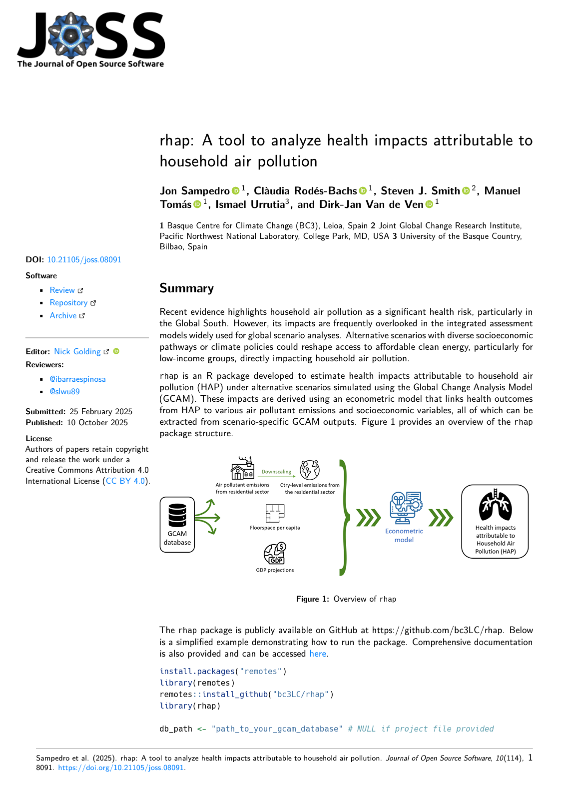
SHORT DESCRIPTION:Recent evidence highlights household air pollution as a significant health risk, particularly in the Global South. However, its impacts are frequently overlooked in the integrated assessment models widely used for global scenario analyses. Alternative scenarios with diverse socioeconomic pathways or climate policies could reshape access to affordable clean energy, particularly for low-income groups, directly impacting household air pollution.
rhap is an R package developed to estimate health impacts attributable to household air pollution (HAP) under alternative scenarios simulated using the Global Change Analysis Model (GCAM). These impacts are derived using an econometric model that links health outcomes from HAP to various air pollutant emissions and socioeconomic variables, all of which can be extracted from scenario-specific GCAM outputs. Figure 1 provides an overview of the rhap package structure.
JOURNAL LINK: https://doi.org/10.21105/joss.08091
ZENODO LINK: https://zenodo.org/records/17338921
SYNERGIES: IAM COMPACT
-
2025
Influence of individual models and studies on quantitative mitigation findings in the IPCC Sixth Assessment Report
DATE: October 2nd, 2025
AUTHORS: Ida Sognnaes | Glen Peters
JOURNAL: Nature Communications
TITLE: Influence of individual models and studies on quantitative mitigation findings in the IPCC Sixth Assessment Report
SHORT DESCRIPTION:Quantitative mitigation findings based on emissions scenarios submitted to the Intergovernmental Panel on Climate Change (IPCC) play an authoritative role in climate policy and decision making. We analyse the impact of the uneven representation of models and modelling studies in the IPCC Sixth Assessment Report (AR6) on statistical values that are used to present quantitative mitigation findings. We find that several key AR6 findings are influenced considerably by the model with the most scenarios, including emissions reductions by 2030 and the decline in fossil fuels consistent with 1.5 °C, and we find that the year of net-zero greenhouse gas emissions is influenced considerably by both the model and the study with the most scenarios. We find that weighting by model- or study does not provide a straightforward solution and discuss three issues related to the use of database statistics to present emissions scenarios findings. Informed by the purpose of the IPCC and the kinds of insights that can be obtained from emissions scenarios, we suggest improvements to the assessment of emissions scenarios.
JOURNAL LINK: https://doi.org/10.1038/s41467-025-64091-w
ZENODO LINK: https://zenodo.org/records/17339461
SYNERGIES: IAM COMPACT
-
2025
The role of artificial intelligence in climate change scientific assessments
DATE: September 12th, 2025
AUTHORS: Alaa Al Khourdajie
JOURNAL: PLOS Climate
TITLE: The role of artificial intelligence in climate change scientific assessments
SHORT DESCRIPTION:Climate change scientific assessments prepared by the Intergovernmental Panel on Climate Change (IPCC) face interconnected dual challenges: the exponential growth of literature, hindering synthesis efficiency, and the increasing length of its reports, impeding accessibility. Building upon the emerging discussion of adopting artificial intelligence (AI) tools in scientific assessments, this essay develops specific operational and governance frameworks to guide the IPCC’s integration of these tools. It makes three distinct contributions. First, it develops a systematic framework for AI-augmented evidence synthesis, detailing how machine learning (ML) can be integrated into each stage of the assessment workflow. Second, it provides a critical analysis of Large Language Models’ (LLMs) use for reports communication through the lens of ‘addressable’ versus ‘inherent’ limitations, clarifying which risks require technical solutions versus those that demand robust governance. Finally, it proposes a novel governance structure for the IPCC based on two institutional roles, the ‘producer’ and the ‘assessor’ of AI products, to ensure scientific integrity is maintained. This essay provides a clear path for the responsible, expert-led integration of AI, ensuring it serves to augment, not replace, human expertise.
JOURNAL LINK: https://doi.org/10.1371/journal.pclm.0000706
ZENODO LINK: https://zenodo.org/records/17406736
SYNERGIES:
-
2025
Divergent effects of economic and behavioural climate policy coupling at the individual and system levels (preprint)
DATE: September 1st, 2025
AUTHORS: Anne Günther | Mart van der Kam | Amir Hosein Hadian Rasanan | Sebastian Gluth | Ulf Hahnel
JOURNAL: Research Square
TITLE: Divergent effects of economic and behavioural climate policy coupling at the individual and system levels (preprint)
SHORT DESCRIPTION:Policy coupling can accelerate demand-side climate mitigation strategies, such as the shift to electric vehicles. Yet, a holistic understanding of joint policy effects at the individual and system levels remains limited. Here, we combine choice experiments and attention process tracing with system-level modelling to examine how a carbon tax and climate information intervention – individually and combined – influence people’s attention and decisions, electric vehicle diffusion, and public policy support. Our findings based on data from four culturally-diverse countries (Mexico, South Africa, USA, UK; N=1,589) show that policies competed for attention but had additive effects on adoption decisions. Integrating the empirical data into an agent-based model showed that combined interventions can, however, have superadditive system-level effects depending on diffusion stage. Finally, support for tax-inclusive policy packages was higher when coupled with climate information policies. Our findings show that policy coupling can enhance impact, depending on diffusion stage, target population, and national context.
JOURNAL LINK: https://doi.org/10.21203/rs.3.rs-7488981/v1
ZENODO LINK:
SYNERGIES:
-
2025
Four scenarios for an IPCC navigating Artificial Intelligence (working paper)
DATE: September 1st, 2025
AUTHORS: Holly Jean Buck | Alaa Al Khourdajie | Shinichiro Asayama | Oliver Geden
JOURNAL: Stiftung Wissenschaft und Politik - Research Division EU/Europe
TITLE: Four scenarios for an IPCC navigating Artificial Intelligence (working paper)
SHORT DESCRIPTION:During the first six assessment cycles of the Intergovernmental Panel on Climate Change (IPCC), generative artificial intelligence (AI) tools were not widely available. This is rapidly changing. The IPCC will need to make choices about how to use artificial intelligencepowered applications in three areas: literature identification, literature assessment, and communicating the contents of the report. These are not merely technical decisions, but socio-political challenges, as the IPCC is not just about synthesizing literature or reportwriting but has a social function of creating a shared basis of reality for addressing climate change. To explore these challenges, this paper describes four scenarios of potential AI development — futures that see the rapid adoption of AI agents, societal perception of AI as more reliable than humans, a precautionary approach to AI from scientific communities, and public backlash to AI in general. Each of these futures present particular challenges and opportunities for the IPCC as an institution, authors of the report, and science and society. However, if the IPCC can navigate social challenges such as the intersection of AI and inclusivity and societal polarization around AI, there is an opportunity for the institution to serve as a model and learning opportunity for other institutions grappling with how to do scientific assessment in a world with generative AI.
JOURNAL LINK: https://www.swp-berlin.org/en/publication/four-scenarios-for-an-ipcc-navigating-artificial-intelligence
ZENODO LINK:
SYNERGIES: IAM COMPACT
-
2025
Navigating the unexpected: The impact of disruptive events on mitigation scenarios (preprint)
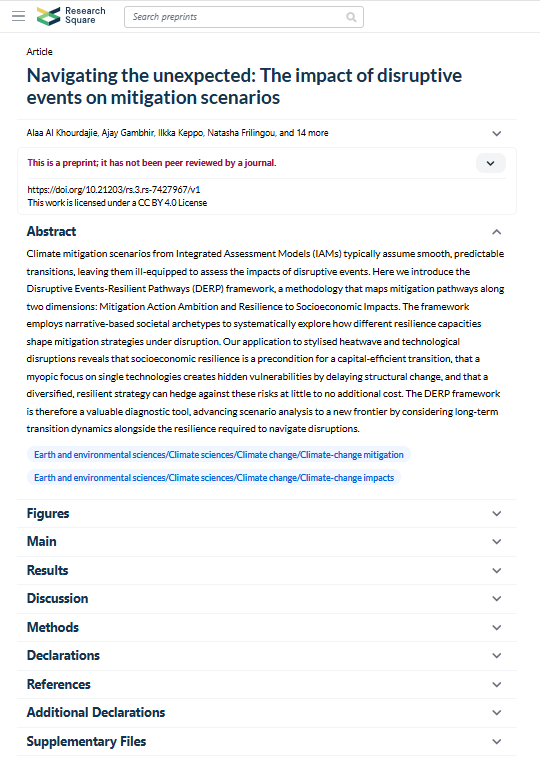
DATE: August 29th, 2025
AUTHORS: Alaa Al Khourdajie | Ajay Gambhir | Natasha Frilingou | Shivika Mittal | Dirk-Jan van de Ven | Panagiotis Fragkos | Christopher Wells | William Schoenberg | Haewon McJeon | Edward Byers | Glen Peters | David McCollum | Eleftheria Zisarou | Chris Smith | Michael Westphal | Adam Hawkes | Alexandros Nikas
JOURNAL: Research Square
TITLE: Navigating the unexpected: The impact of disruptive events on mitigation scenarios (preprint)
SHORT DESCRIPTION:Climate mitigation scenarios from Integrated Assessment Models (IAMs) typically assume smooth, predictable transitions, leaving them ill-equipped to assess the impacts of disruptive events. Here we introduce the Disruptive Events-Resilient Pathways (DERP) framework, a methodology that maps mitigation pathways along two dimensions: Mitigation Action Ambition and Resilience to Socioeconomic Impacts. The framework employs narrative-based societal archetypes to systematically explore how different resilience capacities shape mitigation strategies under disruption. Our application to stylised heatwave and technological disruptions reveals that socioeconomic resilience is a precondition for a capital-efficient transition, that a myopic focus on single technologies creates hidden vulnerabilities by delaying structural change, and that a diversified, resilient strategy can hedge against these risks at little to no additional cost. The DERP framework is therefore a valuable diagnostic tool, advancing scenario analysis to a new frontier by considering long-term transition dynamics alongside the resilience required to navigate disruptions.
JOURNAL LINK: https://doi.org/10.21203/rs.3.rs-7427967/v1
ZENODO LINK:
SYNERGIES: IAM COMPACT
-
2025
APOLLO-Live: A multi-criteria-based webtool for synchronous group decision making and consensus support in energy and climate policy deliberations (revised)
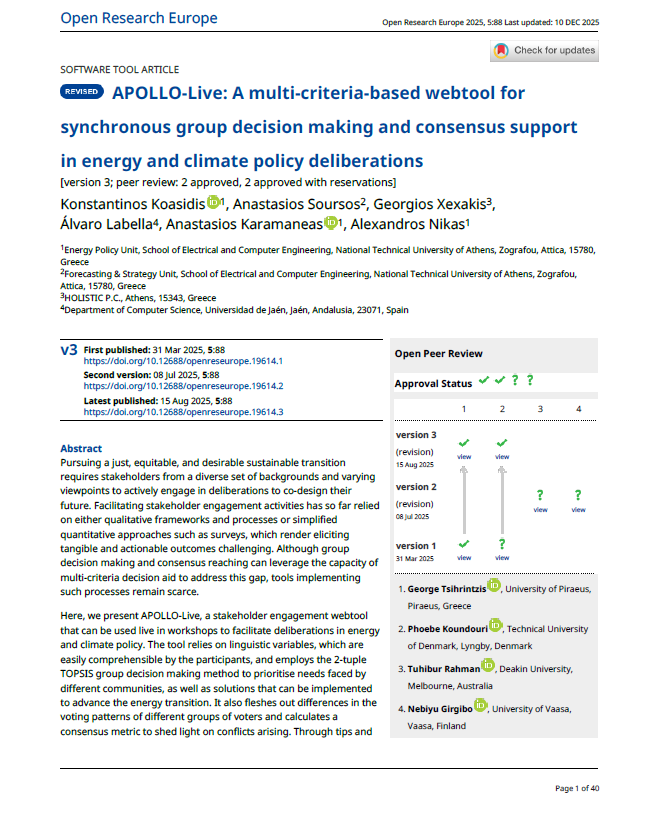
DATE: August 15th, 2025
AUTHORS: Konstantinos Koasidis | Anastasios Soursos | Georgios Xexakis | Álvaro Labella | Anastasios Karamaneas | Alexandros Nikas
JOURNAL: Open Research Europe
TITLE: APOLLO-Live: A multi-criteria-based webtool for synchronous group decision making and consensus support in energy and climate policy deliberations (revised)
SHORT DESCRIPTION:Pursuing a just, equitable, and desirable sustainable transition requires stakeholders from a diverse set of backgrounds and varying viewpoints to actively engage in deliberations to co-design their future. Facilitating stakeholder engagement activities has so far relied on either qualitative frameworks and processes or simplified quantitative approaches such as surveys, which render eliciting tangible and actionable outcomes challenging. Although group decision making and consensus reaching can leverage the capacity of multi-criteria decision aid to address this gap, tools implementing such processes remain scarce.
Here, we present APOLLO-Live, a stakeholder engagement webtool that can be used live in workshops to facilitate deliberations in energy and climate policy. The tool relies on linguistic variables, which are easily comprehensible by the participants, and employs the 2-tuple TOPSIS group decision making method to prioritise needs faced by different communities, as well as solutions that can be implemented to advance the energy transition. It also fleshes out differences in the voting patterns of different groups of voters and calculates a consensus metric to shed light on conflicts arising. Through tips and suggestions provided within the tool and based on multiple rounds of voting, supplemented by live discussions during the workshop, the tool can improve consensus and synthesise multiple perspectives in the produced outcomes, assisting towards bridging the conflicts and producing solutions that are widely accepted.
We highlight the functionalities of the webtool, including how it can be used to advance stakeholder dialogues, in two pilot use cases targeting the preferences of the youth in terms of (a) actions to advance climate action and (b) investments to be prioritised. Finally, although the development and use principles followed focused on the energy and climate policy domain, the tool can be used in any application where multi-criteria decision aid and group decision making can potentially be employed.
JOURNAL LINK: https://doi.org/10.12688/openreseurope.19614.3
ZENODO LINK: https://zenodo.org/records/16307042
SYNERGIES:
-
2025
GCAM-Europe v7.2.0: Enhancing policy-relevant climate modelling through spatial and sectoral detail (preprint)
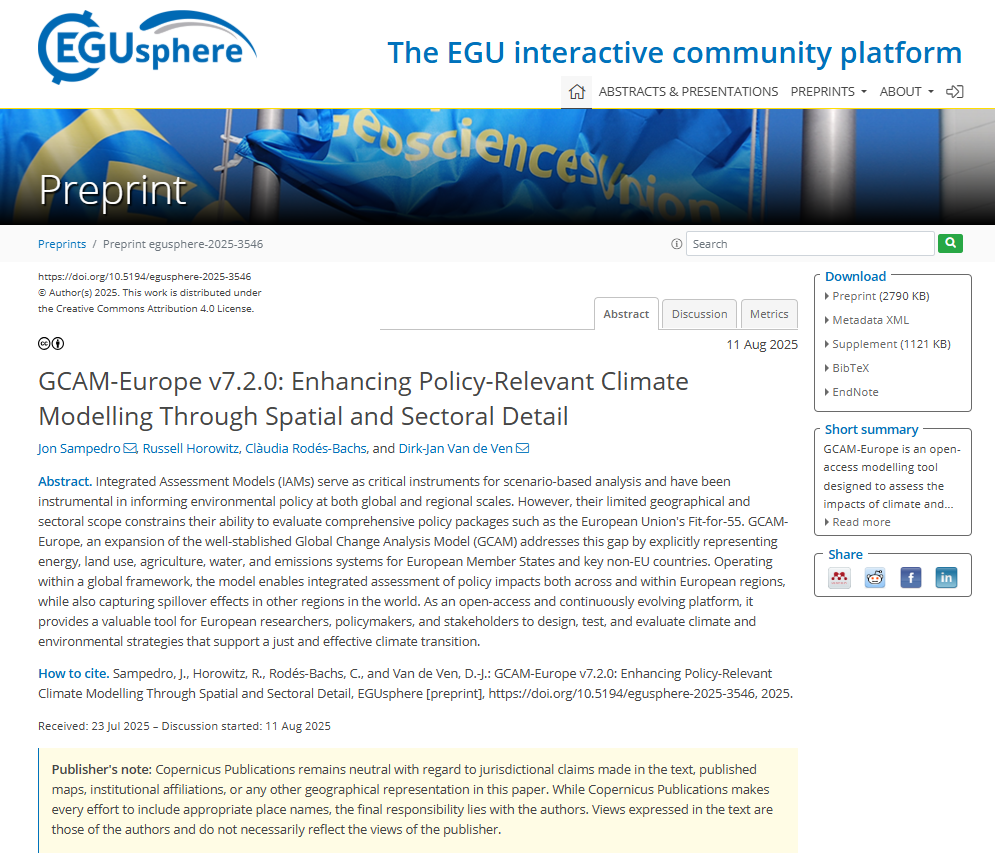
DATE: August 11th, 2025
AUTHORS: Jon Sampedro | Russell Horowitz | Clàudia Rodés-Bachs | Dirk-Jan Van de Ven
JOURNAL: EGUsphere
TITLE: GCAM-Europe v7.2.0: Enhancing policy-relevant climate modelling through spatial and sectoral detail (preprint)
SHORT DESCRIPTION:Integrated Assessment Models (IAMs) serve as critical instruments for scenario-based analysis and have been instrumental in informing environmental policy at both global and regional scales. However, their limited geographical and sectoral scope constrains their ability to evaluate comprehensive policy packages such as the European Union’s Fit-for-55. GCAM-Europe, an expansion of the well-stablished Global Change Analysis Model (GCAM) addresses this gap by explicitly representing energy, land use, agriculture, water, and emissions systems for European Member States and key non-EU countries. Operating within a global framework, the model enables integrated assessment of policy impacts both across and within European regions, while also capturing spillover effects in other regions in the world. As an open-access and continuously evolving platform, it provides a valuable tool for European researchers, policymakers, and stakeholders to design, test, and evaluate climate and environmental strategies that support a just and effective climate transition.
JOURNAL LINK: https://doi.org/10.5194/egusphere-2025-3546
ZENODO LINK: https://zenodo.org/records/17493382 poster
SYNERGIES:
-
2025
A window of (missed) opportunity? A comprehensive stocktake and energy-system impact assessment of global COVID-19 recovery packages
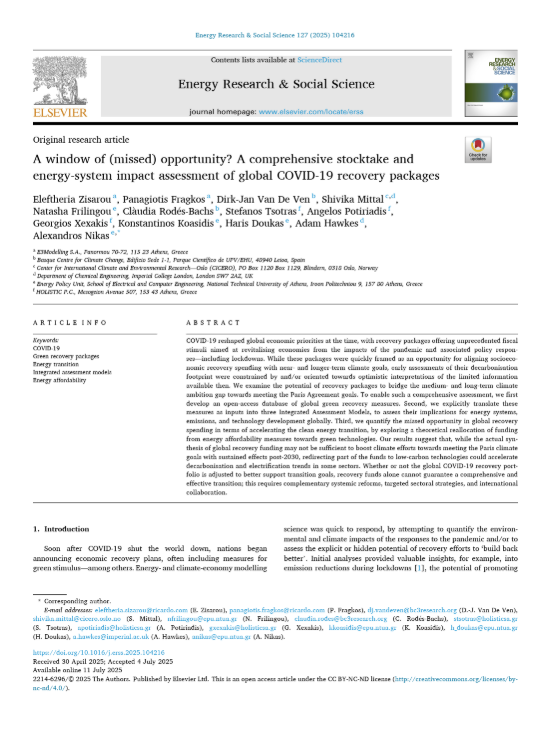
DATE: July 11th, 2025
AUTHORS: Eleftheria Zisarou | Panagiotis Fragkos | Dirk-Jan Van De Ven | Shivika Mittal | Natasha Frilingou | Clàudia Rodés-Bachs | Stefanos Tsotras | Angelos Potiriadis | Georgios Xexakis | Konstantinos Koasidis | Haris Doukas | Adam Hawkes | Alexandros Nikas
JOURNAL: Energy Research & Social Science
TITLE: A window of (missed) opportunity? A comprehensive stocktake and energy-system impact assessment of global COVID-19 recovery packages
SHORT DESCRIPTION:COVID-19 reshaped global economic priorities at the time, with recovery packages offering unprecedented fiscal stimuli aimed at revitalising economies from the impacts of the pandemic and associated policy responses—including lockdowns. While these packages were quickly framed as an opportunity for aligning socioeconomic recovery spending with near- and longer-term climate goals, early assessments of their decarbonisation footprint were constrained by and/or oriented towards optimistic interpretations of the limited information available then. We examine the potential of recovery packages to bridge the medium- and long-term climate ambition gap towards meeting the Paris Agreement goals. To enable such a comprehensive assessment, we first develop an open-access database of global green recovery measures. Second, we explicitly translate these measures as inputs into three Integrated Assessment Models, to assess their implications for energy systems, emissions, and technology development globally. Third, we quantify the missed opportunity in global recovery spending in terms of accelerating the clean energy transition, by exploring a theoretical reallocation of funding from energy affordability measures towards green technologies. Our results suggest that, while the actual synthesis of global recovery funding may not be sufficient to boost climate efforts towards meeting the Paris climate goals with sustained effects post-2030, redirecting part of the funds to low-carbon technologies could accelerate decarbonisation and electrification trends in some sectors. Whether or not the global COVID-19 recovery portfolio is adjusted to better support transition goals, recovery funds alone cannot guarantee a comprehensive and effective transition; this requires complementary systemic reforms, targeted sectoral strategies, and international collaboration.
JOURNAL LINK: https://doi.org/10.1016/j.erss.2025.104216
ZENODO LINK: https://zenodo.org/records/15880757
SYNERGIES: IAM COMPACT
-
2025
An exploration and evaluation framework for climate change mitigation scenarios with varying feasibility and desirability
DATE: June 6th, 2025
AUTHORS: Hamish Beath | Shivika Mittal | Robin Lamboll | Joeri Rogelj
JOURNAL: Environmental Research Letters
TITLE: An exploration and evaluation framework for climate change mitigation scenarios with varying feasibility and desirability
SHORT DESCRIPTION:Ensembles of climate change mitigation scenarios present users with a collection of strategies for limiting global warming. These strategies may differ in their associated feasibility challenges, mitigation co-impacts, and ultimately their relative societal desirability. Understanding these scenario characteristics is therefore crucial when scenarios are used to inform strategic decisions. One approach to enhance this understanding is to establish scenario archetypes and select contrasting illustrative scenarios from a larger ensemble. We present a new multidimensional framework for the systematic comparison of scenarios at the global or regional level. We illustrate the framework with comparisons in seven dimensions: economic feasibility, mineral resource availability, impacts on societal resilience, near-term scenario robustness, environmental sustainability, interregional fairness, and speed of societal transformation. Using cluster analysis, the framework can be used to select a group of illustrative scenarios with contrasting scores across the dimensions. Beyond the selection of scenarios, our exploration and evaluation framework also allows the identification of gaps in the scenario space that may be of interest but are not covered by the literature. We demonstrate these use cases by applying our framework to a set of mitigation scenarios that limit warming to 1.5 °C. Our results show our framework systematically selects contrasting scenarios, with our illustrative pathways having diverging energy mixes and uses of carbon dioxide removal. Further, we highlight considerable regional differences in the distribution of indicator and dimension scores as a key area for further investigation.
JOURNAL LINK: http://www.doi.org/10.1088/1748-9326/addd35
ZENODO LINK: https://zenodo.org/records/15691353
SYNERGIES:
-
2025
Open science practices in Integrated Assessment Models (revised)
DATE: June 16th, 2025
AUTHORS: Clàudia Rodés-Bachs | Jon Sampedro | Natasha Frilingou | Francesco Gardumi | Camilla Lo Giudice
JOURNAL: Open Research Europe
TITLE: Open science practices in Integrated Assessment Models (revised)
SHORT DESCRIPTION:Open science emphasizes the free and accessible dissemination of scholarly outputs to a wide audience, including scientists, stakeholders, and the general public. Its core principle is the open sharing of knowledge to enable reuse, replication, and uphold research integrity. Using insights from a survey designed to explore the open science practices within integrated assessment modeling (IAM) teams, as well as the challenges and barriers they face, we propose an open science protocol tailored specifically to the needs of IAMs. The proposed protocol improves the transparency, accessibility, reliability, reusability, and interoperability of IAM models and results. Grounded in the findability, accessibility, interoperability, and reusability (FAIR) and transparency, responsibility, user focus, sustainability, and technology (TRUST) principles, it supports the transformation of models’ outputs into real-world applications. By fostering enhanced trust and engagement from policymakers, this protocol supports the broader adoption of open science in IAMs. It is complemented by a checklist and includes recommendations for open-source platforms and tools, simplifying workflows and minimizing the need for specialized expertise.
JOURNAL LINK: https://doi.org/10.12688/openreseurope.18824.2
ZENODO LINK: https://zenodo.org/records/15960815
SYNERGIES: IAM COMPACT
-
2025
Empowering change: A self-control perspective on how choice architecture interventions can promote sustainable behavior change

DATE: March 1st, 2025
AUTHORS: Lukas Engel | Charlotte Kukowski | Ulf J. Hahnel
JOURNAL: Motivation Science
TITLE: Empowering change: A self-control perspective on how choice architecture interventions can promote sustainable behavior change
SHORT DESCRIPTION:Choice architecture interventions have been recognized as effective tools for promoting behavior change. While existing descriptive frameworks and taxonomies can help elucidate the important role of microenvironments in shaping behavior, such approaches rarely and inconsistently localize underlying psychological mechanisms, leaving it open when and why such interventions work (or not). Here, we argue that choice architecture interventions primarily operate by influencing self-control processes that immediately precede behavioral enactment. By bridging the two research lines on choice architecture and self-control, we conceptually map how different types of choice architecture interventions can facilitate sustainable behavior change by acting upon specific components of the self-control process. We thereby address the need for (a) a better integration of choice architecture interventions into behavioral theories by clarifying the psychological mechanisms underlying their effects and (b) a stronger consideration of self-control processes in explaining sustainable behavior. We derive testable hypotheses from our approach for future empirical research and discuss implications of our research for evidence-based intervention design to promote sustainable behavior change.
JOURNAL LINK: https://doi.org/10.1037/mot0000396
ZENODO LINK:
SYNERGIES:
-
2025
The global implications of a Russian gas pivot to Asia
DATE: January 4th, 2025
AUTHORS: Steve Pye | Michael Bradshaw | James Price | Dan Zhang | Caroline Kuzemko | Jack Sharples | Dan Welsby | Paul E. Dodds
JOURNAL: Nature Communications
TITLE: The global implications of a Russian gas pivot to Asia
SHORT DESCRIPTION:Recent years have seen unprecedented shifts in global natural gas trade, precipitated in large part by Russia’s war on Ukraine. How this regional conflict impacts the future of natural gas markets is subject to three interconnected factors: (i) Russia’s strategy to regain markets for its gas exports; (ii) Europe’s push towards increased liquified natural gas (LNG) and the pace of its low carbon transition; and (iii) China’s gas demand and how it balances its climate and energy security objectives. A scenario modelling approach is applied to explore the potential implications of this geopolitical crisis. We find that Russia struggles to regain pre-crisis gas export levels, with the degrees of its success contingent on China’s strategy. Compared to 2020, Russia’s gas exports are down by 31–47% in 2040 where new markets are limited and by 13–38% under a pivot to Asia strategy. We demonstrate how integrating energy geopolitics and modelling enhances our understanding of energy futures.
JOURNAL LINK: https://doi.org/10.1038/s41467-024-55697-7
ZENODO LINK:
SYNERGIES:
-
2025
Energy and socioeconomic system transformation through a decade of IPCC-assessed scenarios
DATE: January 3rd, 2025
AUTHORS: Dirk-Jan van de Ven | Shivika Mittal | Alexandros Nikas | Georgios Xexakis | Ajay Gambhir | Lukas Hermwille | Panagiotis Fragkos | Wolfgang Obergassel | Mikel González-Eguino | Faidra Filippidou | Ida Andrea Braathen Sognnaes | Laura Clarke | Glen Peters
JOURNAL: Nature Climate Change
TITLE: Energy and socioeconomic system transformation through a decade of IPCC-assessed scenarios
SHORT DESCRIPTION:Charting future emissions pathways is a central tenet of IPCC assessment reports (AR), yet it is unclear how underlying drivers (including around policy and technology) have influenced the evolution of emissions pathways. Here we compare scenarios in AR5 and AR6 and find that scenarios without specific climate policies enforced have shifted lower in each scenario generation, owing to falling low-carbon technology costs and reduced expectations for economic growth, reducing fossil-fuel shares in energy and industry. Mitigation pathways consistent with 1.5–2 °C have seen increasing electrification rates and higher shares of variable renewables in electricity in more recent scenario generations, implying reduced reliance on coal, nuclear, bioenergy and carbon capture and storage, reflecting changing costs. Despite the shrinking carbon budget due to insufficient recent climate action, mitigation costs have not increased given more optimistic low-carbon technology cost projections. Moving forward, scenario producers must continually recalibrate to keep abreast of technology, policy and societal developments to remain policy relevant.
JOURNAL LINK: https://doi.org/10.1038/s41558-024-02198-6
ZENODO LINK: https://zenodo.org/records/14609256
SYNERGIES: NDC ASPECTS
-
2025
Effects of monetary policy rates on energy technologies: Implications for the European green transition (working paper)
DATE: January 1st, 2025
AUTHORS: Alexandra (Sasha) Serebriakova | Friedemann Polzin | Mark Sanders
JOURNAL: Leibniz Information Centre for Economics (ZBW)
TITLE: Effects of monetary policy rates on energy technologies: Implications for the European green transition
SHORT DESCRIPTION:A swift transition to renewable energy sources in the European Union is necessary for mitigating climate change. However, in a period of higher ECB policy rates meant to combat inflation, it is unclear how monetary policy impacts renewable energy installation. Prior research shows heterogeneous effects of policy rates on sectors with varying industrial characteristics, meaning that renewable technologies may be hit disproportionately by monetary contractions due to their investment requirements, life-cycle stage, and/or dependence on external finance. This paper uses fixed effects panel analysis of 27 European countries to look at the interactions between installed capacity of 10 utility-scale energy technologies, their characteristics, and monetary policy. Over the period of 2001-2021, fossil fuel, hydropower and nuclear technologies were positively affected by monetary contractions, while a 25 basis point rise in policy rates was associated with an 8% decrease in the new installed capacity of wind offshore plants, and a 26.5% decrease for solar PV. Significant interaction effects using measures of investment intensity and external finance dependence for energy technologies, yield evidence in favour of the interest rate and balance sheet channels of monetary policy transmission. To address endogeneity concerns, we use a two-stage least squares (2SLS) approach in an LCOE specification for the interest rate channel in the energy sector which confirms these findings. Our results suggest the existence of an unintended bias in contractionary monetary operations and central banks should consider flanking policies (such as preferred interest rates) to offset the disadvantage for renewables.
JOURNAL LINK: https://hdl.handle.net/10419/316394
ZENODO LINK:
SYNERGIES:
-
2024
Reducing the cost of capital to finance the energy transition in developing countries

DATE: September 27th, 2024
AUTHORS: Matteo Calcaterra | Lara Aleluia Reis | Panagiotis Fragkos | Thibault Briera | Harmen Sytze de Boer | Florian Egli | Johannes Emmerling | Gokul Iyer | Shivika Mittal | Friedemann Polzin | Mark Sanders | Tobias Schmidt | Alexandra (Sasha) Serebriakova | Bjarne Steffen | Dirk-Jan van de Ven | Detlef van Vuuren | Paul Waidelich | Massimo Tavoni
JOURNAL: Nature Energy
TITLE: Reducing the cost of capital to finance the energy transition in developing countries
SHORT DESCRIPTION:Climate stabilization requires the mobilization of substantial investments in low- and zero-carbon technologies, especially in emerging and developing economies. However, access to stable and affordable finance varies dramatically across countries. Models used to evaluate the energy transition do not differentiate regional financing costs and therefore cannot study risk-sharing mechanisms for renewable electricity generation. In this study, we incorporated the empirically estimated cost of capital differentiated by country and technology into an ensemble of five climate–energy–economy models. We quantified the additional financing cost of decarbonization borne by developing regions and explored policies of risk premium convergence across countries. We found that alleviating financial constraints benefits both climate and equity as a result of more renewable and affordable energy in the developing world. This highlights the importance of fair finance for energy availability, affordability and sustainability, as well as the need to include financial considerations in model-based assessments.
JOURNAL LINK: https://doi.org/10.1038/s41560-024-01606-7
ZENODO LINK: https://zenodo.org/records/13864212
SYNERGIES: PRISMA
-
2024
Projecting progress in sustainable development goals vis-à-vis climate action in climate-economy models

DATE: July 16th, 2024
AUTHORS: Alexandros Nikas
JOURNAL: PLOS Climate
TITLE: Projecting progress in sustainable development goals vis-à-vis climate action in climate-economy models
SHORT DESCRIPTION:The year 2015 was an important milestone in the world’s struggle for sustainability. Although mostly remembered for the landmark Paris Agreement, which formalised and operationalised a mechanism for globally coordinated and cooperative efforts to address the climate crisis, it also featured the UN-wide adoption of the 2030 Agenda for Sustainable Development, embodied in seventeen distinct yet highly intertwined dimensions—the Sustainable Development Goals (SDGs). The scientific community has since attempted to actively support the assessment of progress and prospects/trends towards sustainability using an array of tools as interdisciplinary and diverse as the SDG agenda itself. However, such studies are mostly static and capture an overview of how far we still need to go. This piece discusses six ways, in which the capacity to evaluate progress in SDGs vis-à-vis efforts to mitigate climate change using IAMs is currently being enhanced to offer robust and actionable policy prescriptions that may place climate policy in a holistic sustainable development context
JOURNAL LINK: https://doi.org/10.1371/journal.pclm.0000449
ZENODO LINK: https://zenodo.org/records/12760230
SYNERGIES: IAM COMPACT
-
2024
Industrial European regions at risk within the Fit for 55: How far implementing CBAM can mitigate?

DATE: June 24th, 2024
AUTHORS: Sigit Perdana | Marc Vielle
JOURNAL: Renewable and Sustainable Energy Transition
TITLE: Industrial European regions at risk within the Fit for 55: How far implementing CBAM can mitigate?
SHORT DESCRIPTION:The transition to a low-carbon economy can create new job opportunities but may cause job displacement in some sectors that heavily rely on fossil fuels. In order to gain a balanced appraisal in understanding the broader consequences of climate policies, this paper analyses the impact of the EU Fit for 55 with carbon border adjustment on EU employment at the regional level. Research findings prove that certain regions are disproportionately affected by job losses, indicating that the acceptability of these targeted policies should address these potential inequalities. The most exposed are regions with vast energy mining industries, however implementing CBAM reduces the exposure of regions with energy-intensive industries. Some regions in Greece, Spain and Italy are still very vulnerable post-CBAM implementation, suggesting high sensitivity of job losses and low capability of these regions to deal with energy transition. Accordingly, ensuring effective support for these vulnerable regions is critical to enhancing public acceptance and further cooperation for the EU climate commitment and a more well-managed transition to a low-carbon economy.
JOURNAL LINK: https://doi.org/10.1016/j.rset.2024.100088
ZENODO LINK:
SYNERGIES:
-
2024
Energy system analysis of cutting off Russian gas supply to the European Union

DATE: July 7th, 2024
AUTHORS: Jon Sampedro | Dirk-jan Van de Ven | Russell Horowitz | Clàudia Rodés-Bachs | Natasha Frilingou | Alexandros Nikas | Matthew Binsted | Gokul Iyer | Brinda Yarlagadda
JOURNAL: Energy Strategy Reviews
TITLE: Energy system analysis of cutting off Russian gas supply to the European Union
SHORT DESCRIPTION:The reduction of the EU’s pipeline gas imports from Russia because of the Russian war against Ukraine has had severe economy-wide implications for the bloc. Using a multisector integrated assessment model (GCAM), we find that a potential complete cut-off of Russian pipeline gas exports to the EU unevenly impacts the energy mix and gas prices across subregions within the EU, depending on their access to alternative gas pipelines and liquefied natural gas infrastructure. The restrictions also affect global gas infrastructure capacity additions, asset stranding, and trade dynamics. Our results show that the Fit-for-55 policy framework already improves the EU’s resilience against a cut-off of Russian pipeline gas, while additional improvements in energy efficiency and renewable targets could further soften impacts.
JOURNAL LINK: https://doi.org/10.1016/j.esr.2024.101450
ZENODO LINK: https://doi.org/10.1016/j.esr.2024.101450 | https://zenodo.org/records/10512544
SYNERGIES: IAM COMPACT
-
2024
Global high-resolution growth projections dataset for rooftop area consistent with the shared socioeconomic pathways, 2020–2050

DATE: May 30th, 2024
AUTHORS: Siddharth Joshi | Behnam Zakeri | Shivika Mittal | Alessio Mastrucci | Paul Holloway | Volker Krey | Priyadarshi Ramprasad Shukla | Brian O’Gallachoir | James Glynn
JOURNAL: Scientific Data
TITLE: Global high-resolution growth projections dataset for rooftop area consistent with the shared socioeconomic pathways, 2020–2050
SHORT DESCRIPTION:Assessment of current and future growth in the global rooftop area is important for understanding and planning for a robust and sustainable decentralised energy system. These estimates are also important for urban planning studies and designing sustainable cities thereby forwarding the ethos of the Sustainable Development Goals 7 (clean energy), 11 (sustainable cities), 13 (climate action) and 15 (life on land). Here, we develop a machine learning framework that trains on big data containing ~700 million open-source building footprints, global land cover, road, and population datasets to generate globally harmonised estimates of growth in rooftop area for five different future growth narratives covered by Shared Socioeconomic Pathways. The dataset provides estimates for ~3.5 million fishnet tiles of 1/8 degree spatial resolution with data on gross rooftop area for five growth narratives covering years 2020–2050 in decadal time steps. This single harmonised global dataset can be used for climate change, energy transition, biodiversity, urban planning, and disaster risk management studies covering continental to conurbation geospatial levels.
JOURNAL LINK: https://doi.org/10.1038/s41597-024-03378-x
ZENODO LINK: https://doi.org/10.5281/zenodo.11085013
SYNERGIES: CircEUlar
-
2024
The impacts of decarbonization pathways on Sustainable Development Goals in the European Union

DATE: March 16th, 2024
AUTHORS: Jorge Moreno | Lorenza Campagnolo | Baptiste Boitier | Alexandros Nikas | Konstantinos Koasidis | Ajay Gambhir | Mikel Gonzalez-Eguino | Sigit Perdana | Dirk-Jan Van de Ven | Alessandro Chiodi | Elisa Delpiazzo | Haris Doukas | Maurizio Gargiulo | Andrea Herbst | Khaled Al-Dabbas | Şirin Alibaş | Felix Neuner | Pierre Le Mouël | Marc Vielle
JOURNAL: Communications Earth & Environment
TITLE: The impacts of decarbonization pathways on Sustainable Development Goals in the European Union
SHORT DESCRIPTION:Climate action to achieve the Paris Agreement should respect the United Nations Sustainable Development Goals. Here, we use an integrated assessment modelling framework comprising nine climate policy models and quantify the impacts of decarbonisation pathways on Sustainable Development Goals in the European Union at regional and national levels. We show that scenario-consistent assumptions of future socio-economic trends and current climate policies would improve energy- and carbon-related aspects of sustainability and reduce inequalities. Ambitious net-zero emissions pathways would further improve health and agricultural productivity. Furthermore, countries currently lagging in achieving sustainable development goals would see the greatest benefits from ambitious climate action. Negative socio-economic impacts from climate action on poverty, hunger, and economic growth will require specific corrective policies. While our analysis does not quantify the negative effects of less ambitious climate policy, it demonstrates where co-benefits and trade-offs of greenhouse gas mitigation and sustainable development agenda exist and can guide policy formulation.
JOURNAL LINK: https://doi.org/10.1038/s43247-024-01309-7
ZENODO LINK: https://doi.org/10.5281/zenodo.10072817
SYNERGIES: PARIS REINFORCE
-
2024
Advancing participatory energy systems modelling
DATE: February 2nd, 2024
AUTHORS: Connor McGookin | Diana Süsser | Georgios Xexakis | Evelina Trutnevyte | Will McDowall | Alexandros Nikas | Konstantinos Koasidis | Sheridan Few | Per Dannemand Andersen | Christina Demski | Patrícia Fortes | Sofia G. Simoes | Christopher Bishop | Fionn Rogan | Brian Ó Gallachóir
JOURNAL: Energy Strategy Reviews
TITLE: Advancing participatory energy systems modelling
SHORT DESCRIPTION:Energy system models are important tools to guide our understanding of current and future carbon dioxide emissions as well as to inform strategies for emissions reduction. These models offer a vital evidence base that increasingly underpins energy and climate policies in many countries. In light of this important role in policy formation, there is growing interest in, and demands for, energy modellers to integrate more diverse perspectives on possible and preferred futures into the modelling process. The main purpose of this is to ensure that the resultant policy decisions are both fairer and better reflect people’s concerns and preferences. However, while there has been a focus in the literature on efforts to bring societal dimensions into modelling tools, there remains a limited number of examples of well-structured participatory energy systems modelling processes and no available how-to guidance. This paper addresses this gap by providing good practice guidance for integrating stakeholder and public involvement in energy systems modelling based on the reflections of a diverse range of experts from this emergent field. The framework outlined in this paper offers multiple entry points for modellers to incorporate participatory elements either throughout the process or in individual stages. Recognising the messiness of both fields (energy systems modelling and participatory research), the good practice principles are not comprehensive or set in stone, but rather pose important questions to steer this process. Finally, the reflections on key issues provide a summary of the crucial challenges and important areas for future research in this critical field.
JOURNAL LINK: https://doi.org/10.1016/j.esr.2024.101319
ZENODO LINK: https://zenodo.org/records/10610295
SYNERGIES:
-
2024
Three different directions in which the European Union could replace Russian natural gas

DATE: January 6th, 2024
AUTHORS: Alexandros Nikas | Natasha Frilingou | Conall Heussaff | Panagiotis Fragkos | Shivika Mittal | Jon Sampedro | Sara Giarola | Jan-Philipp Sasse | Lorenzo Rinaldi | Haris Doukas | Ajay Gambhir | Anastasis Giannousakis | Nicolò Golinucci | Konstantinos Koasidis | Matteo Rocco | Evelina Trutnevyte | Georgios Xexakis | Georg Zachmann | Eleftheria Zisarou | Emanuela Colombo | Adam Hawkes | Brinda Yarlagadda | Matthew Binsted | Gokul Iyer | Rasmus Magni Johannsen | Jakob Zinck Thellufsen | Henrik Lund | Dirk-Jan Van de Ven
JOURNAL: Energy
TITLE: Three different directions in which the European Union could replace Russian natural gas
SHORT DESCRIPTION:Russia’s invasion of Ukraine fuelled an energy crisis, which considerably impacted Europe given its heavy reliance on Russian natural gas imports. This study uses an ensemble of four global integrated assessment models, which are further soft-linked to two sectoral models, and explores the synergies and trade-offs among three approaches to living without Russian gas in Europe: (a) replacing with other gas imports, (b) boosting domestic energy production, and (c) reducing demand and accelerating energy efficiency. We find that substituting Russian gas from other trade partners would miss an opportunity to accelerate decarbonisation in end-use sectors while risking further fossil-fuel lock-ins, despite featuring the lowest gas price spikes and potentially reducing heating costs for end-users in the near term. Boosting domestic, primarily renewable, energy production on the other hand would instead require considerable investments, potentially burdening consumers. Energy demand reductions, however, could offer considerable space for further emissions cuts at the lowest power-sector investment costs; nonetheless, an energy efficiency-driven strategy would also risk relocation of energy-intensive industries, an aspect of increasing relevance to EU policymakers.
JOURNAL LINK: https://doi.org/10.1016/j.energy.2024.130254
ZENODO LINK: https://zenodo.org/records/10464723
SYNERGIES: IAM COMPACT
-
2023
Promoting sustainable transitions across the globe requires scenario co-creation with key stakeholders (editorial)
DATE: December 27th, 2023
AUTHORS: Alexandros Nikas | Ajay Gambhir | Baptiste Boitier
JOURNAL: Renewable and Sustainable Energy Transition
TITLE: Promoting sustainable transitions across the globe requires scenario co-creation with key stakeholders (editorial)
SHORT DESCRIPTION:The Paris Agreement rests on individual countries and regions identifying stretching but feasible mitigation pathways. These must be acceptable and achievable in the eyes of a range of stakeholders in those countries or regions, including those from civil society, governments, and businesses. This Special Issue explores a range of feasible yet ambitious greenhouse gas emissions reduction pathways in a diversity of regions/countries of the world, in principle compatible with the goals of the Paris Agreement on climate change. Each of these pathways have been developed using energy system models or whole-economy models, in most cases using mitigation scenarios co-created with a range of policy, civil society, academic, and business stakeholders.
JOURNAL LINK: https://doi.org/10.1016/j.rset.2023.100076
ZENODO LINK: https://zenodo.org/records/10518689
SYNERGIES: IAM COMPACT
-
2023
A multi-model analysis of the EU’s path to net zero

DATE: November 23rd, 2023
AUTHORS: Baptiste Boitier | Alexandros Nikas | Ajay Gambhir | Konstantinos Koasidis | Alessia Elia | Khaled Al-Dabbas | Şirin Alibaş | Lorenza Campagnolo | Alessandro Chiodi | Elisa Delpiazzo | Haris Doukas | Arnaud Fougeyrollas | Maurizio Gargiulo | Pierre Le Mouël | Felix Neuner | Sigit Perdana | Dirk-Jan van de Ven | Marc Vielle | Paul Zagamé | Shivika Mittal
JOURNAL: Joule
TITLE: A multi-model analysis of the EU’s path to net zero
SHORT DESCRIPTION:The European Union (EU) recently ratcheted its climate ambition to net-zero emissions by 2050, with a milestone of 55% emissions cuts in 2030. This study carries out a model inter-comparison to assess the EU’s path, from “Fit for 55” in 2030 to an intermediate milestone in 2040 and onto net zero in 2050, offering insights at sectoral and member-state levels. Our model results support the bloc’s ambition for its Emissions Trading System and Effort Sharing Regulation sectors while pointing to the need for near-complete decarbonization of electricity by 2040, enabled by considerable deployment of renewables (45%–65% in 2030, to 60%–70% in 2040, and to 75%–90% in 2050 in electricity generation) and carbon capture and storage (0.5–2 GtCO2/year by 2050). We also highlight the trade-offs between supply-side and harder-to-abate sectors, assess the ambition of member states for net zero and timing of coal phaseout, and reflect on the economic implications of investment, technical, and policy needs.
JOURNAL LINK: https://doi.org/10.1016/j.joule.2023.11.002
ZENODO LINK: https://zenodo.org/records/10213459
SYNERGIES: PARIS REINFORCE
-
2023
The EU carbon border adjustment mechanism: implications on Brazilian energy intensive industries

DATE: November 2nd, 2023
AUTHORS: Sigit Perdana | Marc Vielle | Thais Diniz Oliveira
JOURNAL: Climate Policy
TITLE: The EU carbon border adjustment mechanism: implications on Brazilian energy intensive industries
SHORT DESCRIPTION:As an instrument supporting the realization of EU climate neutrality targets by 2050 and encouraging decarbonization outside its borders, the current proposed Carbon Border Adjustment Mechanism (CBAM) is facing opposition from some countries. Focusing on Brazil, this paper evaluates the impacts of the CBAM on the Brazilian economy through a comprehensive analysis of various scenarios based on the potential EU implementation of the CBAM and Brazil’s climate scenarios. Results obtained in this research alleviate concerns of detrimental and competitiveness losses from Brazilian industries. Rather, the implementation of the EU CBAM improves the trade balance of Brazil’s Energy-Intensive Industries (EII). The relatively low CO2 contents of Brazilian EII are elemental to this result, while contributions of carbon-free technologies in electricity generation are also critical factors in maximizing this trade surplus. Other consequential factors affecting these results are the contributions of CO2 removal from Brazil’s forestry of land used, and homogeneity of CBAM-imposed products.
JOURNAL LINK: https://doi.org/10.1080/14693062.2023.2277405
ZENODO LINK: https://zenodo.org/records/10069214
SYNERGIES:
-
2023
A multicriteria modeling approach for evaluating power generation scenarios under uncertainty: The case of green hydrogen in Greece
DATE: October 10th, 2023
AUTHORS: Diamantis Koutsandreas | Georgios P. Trachanas | Ioannis Pappis | Alexandros Nikas | Haris Doukas | John Psarras
JOURNAL: Energy Strategy Reviews
TITLE: A multicriteria modeling approach for evaluating power generation scenarios under uncertainty: The case of green hydrogen in Greece
SHORT DESCRIPTION:Clean energy technological innovations are widely acknowledged as a prerequisite to achieving ambitious long-term energy and climate targets. However, the optimal speed of their adoption has been parsimoniously studied in the literature. This study seeks to identify the optimal intensity of moving to a green hydrogen electricity sector in Greece, using the OSeMOSYS energy modeling framework. Green hydrogen policies are evaluated, first, on the basis of their robustness against uncertainty and, afterwards, against conflicting performance criteria and for different decision-making profiles towards risk, by applying the VIKOR and TOPSIS multi-criteria decision aid methods. Although our analysis focuses exclusively on the power sector and compares different rates of hydrogen penetration compared to a business-as-usual case without considering other game-changing innovations (such as other types of storage or carbon capture and storage), we find that a national transition to a green hydrogen economy can support Greece in potentially cutting at least 16 MtCO2 while stimulating investments of EUR 10–13 bn. over 2030–2050.
JOURNAL LINK: https://doi.org/10.1016/j.esr.2023.101233
ZENODO LINK: https://zenodo.org/records/8427501
SYNERGIES: PARIS REINFORCE
-
2023
Co-creating Canada’s path to net-zero: a stakeholder-driven modelling analysis
DATE: August 1st, 2023
AUTHORS: Alison Bailie | Marie Pied | Kathleen Vaillancourt | Olivier Bahn | Konstantinos Koasidis | Ajay Gambhir | Jakob Wachsmuth | Philine Warnke | Ben McWilliams | Haris Doukas | Alexandros Nikas
JOURNAL: Renewable and Sustainable Energy Transition
TITLE: Co-creating Canada's path to net-zero: a stakeholder-driven modelling analysis
SHORT DESCRIPTION:Canada has pledged ambitious emission targets, aiming to achieve a reduction of at least 40–45% below 2005 levels by 2030 and net-zero emissions by 2050. Being amongst the major economies with high dependence on fossil fuels, however, this path is far from straightforward. This research employs NATEM, a TIMES-based regional energy system model for North America with explicit representation of Canada, as well as knowledge produced and shared by stakeholders during a targeted workshop dedicated to identifying decarbonisation bottlenecks, to compare the paths to net zero on the basis of whether stakeholder perceptions are considered or not. We find that the path to net-zero is technically feasible but critically entails the use of negative emissions technologies, like (bioenergy with) carbon capture and storage (CCS) and direct air capture, in addition to the large-scale deployment of a large range of mitigation options already available today. Based on the feedback received from the stakeholders, around both the use of CCS-based technologies and the potential of demand-side measures such as modal shifts in transportation and better urban planning, we impose a set of additional conditions and restrictions. We find that the co-created net-zero pathway is also technically feasible while relying less on technologies that may trigger bottlenecks prioritised by the stakeholders; notably, despite yielding a similar emissions trajectory, it entails significantly different sectoral and technological configurations to the non-co-created net-zero scenario, requiring an acceleration of near-term abatement measures, mainly through electrification and quicker rollout of renewable and other clean energy technologies.
JOURNAL LINK: https://www.sciencedirect.com/science/article/pii/S2667095X2300017X
ZENODO LINK: https://zenodo.org/records/10069307
SYNERGIES: PARIS REINFORCE
-
2023
In-Cognitive: A web-based Python application for fuzzy cognitive map design, simulation, and uncertainty analysis based on the Monte Carlo method

DATE: July 1st, 2023
AUTHORS: Themistoklis Koutsellis | Georgios Xexakis | Konstantinos Koasidis | Natasha Frilingou | Anastasios Karamaneas | Alexandros Nikas | Haris Doukas
JOURNAL: SoftwareX
TITLE: In-Cognitive: A web-based Python application for fuzzy cognitive map design, simulation, and uncertainty analysis based on the Monte Carlo method
SHORT DESCRIPTION:Fuzzy Cognitive Mapping is a semi-quantitative modelling method, widely used for decision support in various domains. However, existing software applications have been criticised over inadequate handling of uncertain information, lack of accessibility, and inability to converge to solutions for all modelled systems. Here we present In-Cognitive, an open-source, web-based application for the creation, visualisation, and simulation of Fuzzy Cognitive Maps, ensuring solution convergence and allowing for Monte Carlo uncertainty analysis. The application is built in Python and Bokeh and provides an accessible and user-friendly interface to model various systems quickly and reliably and evaluate the robustness of the modelling solutions.
JOURNAL LINK: https://www.sciencedirect.com/science/article/pii/S2352711023002091
ZENODO LINK: https://zenodo.org/records/10069255
SYNERGIES: PARIS REINFORCE
-
2023
Seven key principles for assessing emerging low-carbon technological opportunities for climate change mitigation action

DATE: July 10th, 2023
AUTHORS: Ajay Gambhir | Alexandros Nikas
JOURNAL: PLOS Climate
TITLE: Seven key principles for assessing emerging low-carbon technological opportunities for climate change mitigation action
SHORT DESCRIPTION:It is virtually certain that there is going to be a scramble for technological innovation in the coming years, to ensure that society can operate without today’s vast reliance on fossil fuels and their associated CO2 emissions, nor the emissions of methane (CH4), nitrous oxide (N2O) from agriculture and waste, and other greenhouse gases from human activities. Indeed, it has been estimated that almost half of the technologies making up a net-zero energy system in 2050 are commercially unavailable.
In this technology gold rush, there will inevitably be both successes and failures. Some new technologies will help tackle both climate change and other energy-related or societal challenges (such as energy security and reliance on volatile fossil fuel prices), whereas others—despite their contribution to reducing greenhouse gas emissions—will risk augmenting existing concerns or even give rise to new societal issues (such as local environmental pollution, or bottlenecks and disruptions to communities affected by extraction of energy transition-critical materials and over-reliance on brittle international mineral supply-chains with the associated geo-political tensions that could result).
Furthermore, technology development will not occur in isolation of broader infrastructures (such as roads and city designs, electric vehicle charging networks, district heating, and cooling networks, or hydrogen pipelines). Still, rather technologies will be central “artefacts” within a system of physical, regulatory, and political innovation systems. The success or failure of such systems will depend on multiple actors (including researchers, businesses, investors, governments, and consumers) and factors (regulation, policy, capital availability, information, social legitimacy for new technologies, etc.) as well as the efficacy of their interactions.
JOURNAL LINK: https://journals.plos.org/climate/article?id=10.1371/journal.pclm.0000235
ZENODO LINK: https://zenodo.org/records/8183549
SYNERGIES: IAM COMPACT
-
2023
Carbon border adjustment mechanism in the transition to net-zero emissions: collective implementation and distributional impacts
DATE: February 18th, 2023
AUTHORS: Sigit Perdana | Marc Vielle
JOURNAL: Environmental Economics and Policy Studies
TITLE: Carbon border adjustment mechanism in the transition to net-zero emissions: collective implementation and distributional impacts
SHORT DESCRIPTION:As an instrument to minimize carbon leakage, the effects and feasibility of Carbon Border Adjustments Mechanism (CBAM) will depend on multiple design options. While the EU has committed to introducing CBAM as part of its green climate deal, pursuing climate efforts to successfully limit global warming requires a collective implementation involving major emitters China and the US. This paper quantifies the distributional impacts of a joint CBAM implementation of in a climate alliance or a club of the EU, the US, and China. Differing from a myriad of studies that focus on unilateral CBAM, this analysis emphasizes collective implications on leakage, sectoral competitiveness, and welfare by projecting climate neutrality relative to current policies and climate targets. Our findings confirm that coalition reduces leakage, improves production on energy-intensive industries, and increases club’s welfare relative to a non-CBAM and a unilateral implementation. These are in contrast with some unilateral analytical studies, especially for the US. It is further proof of the potential of CBAM as collective instruments to facilitate mitigation and trade competitiveness.
JOURNAL LINK: https://doi.org/10.1007/s10018-023-00361-5
ZENODO LINK: https://zenodo.org/record/7981970
SYNERGIES: PARIS REINFORCE
-
2023
Reinforcing the Paris Agreement: Ambitious scenarios for the decarbonisation of the Central Asian and Caspian region
DATE: August 1st, 2023
AUTHORS: Gabriele Cassetti | Alessia Elia | Maurizio Gargiulo | Alessandro Chiodi
JOURNAL: Renewable & Sustainable Energy Transition
TITLE: Reinforcing the Paris Agreement: Ambitious scenarios for the decarbonisation of the Central Asian and Caspian region
SHORT DESCRIPTION:For its abundant fossil resources, the Central Asia and Caspian region plays a strategic role in the energy security of major markets, such as Europe and China. However, this dependence on export, added to a firm reliance on fossil fuels for internal consumption, represents a significant challenge for the decarbonisation of the region.
In this paper, we perform an energy scenario analysis of four countries in the region (Azerbaijan, Kazakhstan, Uzbekistan and Turkmenistan), aiming to investigate how ambitious their regional decarbonisation targets for 2050 are in view of the Paris Agreement. We also develop a net-zero emission pathway to reinforce the regional climate ambition in the long term. As a novelty in the literature, the scenario analysis is co-designed with regional stakeholders through an engagement process that we have carried out from December 2020 to May 2021.
The analysis is performed with the TIMES-CAC energy system model. Results show that current regional energy policies are insufficient for achieving ambitious climate targets in the long term (2050 and beyond). The lack of a long-term strategy to decrease the dependence on export increases the influence of importing countries’ energy policies. Even in a decarbonised scenario, the role of China remains significant, while the dependence on the European Union decreases. To limit the pressure from other countries in the energy transition, the region should start implementing a rigorous energy planning process today to fill the “ambition gap” and achieve carbon neutrality in a 40-year horizon.
JOURNAL LINK: https://doi.org/10.1016/j.rset.2023.100048
ZENODO LINK: https://zenodo.org/record/7982082
SYNERGIES: PARIS REINFORCE
STAY UP TO DATE
SUBSCRIBE TO OUR NEWSLETTER









Quick Links
Legal